
Topzle Topzle

United States war plans (1945–1950)

Updated: Wikipedia source
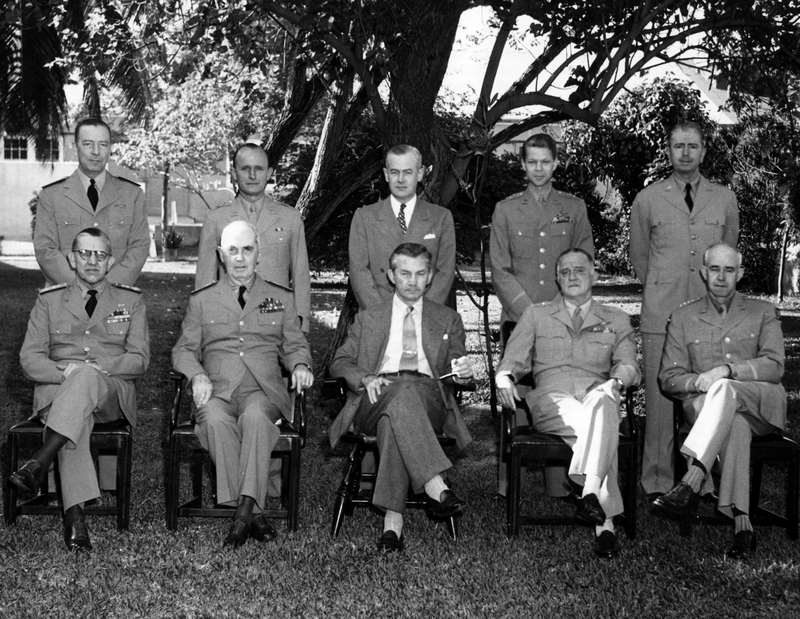
United States war plans (1945–1950)

United States war plans for a conflict with the Soviet Union (USSR) were formulated and revised on a regular basis between 1945 and 1950. Although most were discarded as impractical, they nonetheless would have served as the basis for action had a conflict occurred. At no point was it considered likely that the Soviet Union or United States would resort to war, only that one could potentially occur as a result of a miscalculation. Planning was conducted by agencies of the Joint Chiefs of Staff, in collaboration with planners from the United Kingdom and Canada. American intelligence assessments of the Soviet Union's capabilities were that it could mobilize as many as 245 divisions, of which 120 could be deployed in Western Europe, 85 in the Balkans and Middle East, and 40 in the Far East. All war plans assumed that the conflict would open with a massive Soviet offensive. The defense of Western Europe was regarded as impractical, and the Pincher, Broiler and Halfmoon plans called for a withdrawal to the Pyrenees, while a strategic air offensive was mounted from bases in the United Kingdom, Okinawa, and the Cairo-Suez or Karachi areas, with ground operations launched from the Middle East aimed at southern Russia. By 1949, priorities had shifted, and the Offtackle plan called for an attempt to hold Soviet forces on the Rhine, followed, if necessary, by a retreat to the Pyrenees, or mounting an Operation Overlord–style invasion of Soviet-occupied Western Europe from North Africa or the United Kingdom. Despite doubts about its viability and effectiveness, a strategic air offensive was regarded as the only means of striking back in the short term. The air campaign plan, which steadily grew in size, called for the delivery of up to 292 atomic bombs and 246,900 short tons (224,000 t) of conventional bombs. It was estimated that 85 percent of the industrial targets would be completely destroyed. These included electric power, shipbuilding, petroleum production and refining, and other essential war fighting industries. About 6.7 million casualties were anticipated, of whom 2.7 million would be killed. There was conflict between the United States Air Force and the United States Navy over naval participation in the strategic bombing effort, and whether it was a worthwhile use of resources. The concept of nuclear deterrence did not figure in the plans.

Tables

Projected force levels under the Cogwheel plan [50] · Halfmoon (1948)
Army divisions
Army divisions
Force
Army divisions
At start
20
After one year
40
After two years
80
Air Force groups
Air Force groups
Force
Air Force groups
At start
66
After one year
103
After two years
186
Navy warships
Navy warships
Force
Navy warships
At start
510
After one year
1,785
After two years
2,976
Navy aircraft carriers
Force
Navy aircraft carriers
At start
11
After one year
16
After two years
25
Force
At start
After one year
After two years
Army divisions
20
40
80
Air Force groups
66
103
186
Navy warships
510
1,785
2,976
Navy aircraft carriers
11
16
25

References

  1. Ross 1988, p. 4.
  2. Schnabel 1996, pp. 7–8.
  3. Ross 1988, pp. 4–5.
  4. Schnabel 1996, pp. 91–97.
  5. Schnabel 1996, p. 109.
  6. Carter 2015, p. 8.
  7. Carter 2015, pp. 148–149.
  8. Schnabel 1996, pp. 63–65.
  9. Rearden 2012, p. 95.
  10. Schnabel 1996, pp. 71–72.
  11. Ross 1988, pp. 31–33.
  12. Ross 1988, p. 27.
  13. Ross 1988, pp. 27–30.
  14. Moody 1995, p. 49.
  15. Schnabel 1996, p. 74.
  16. Ross 1988, pp. 34–35.
  17. Ross 1988, pp. 35–36.
  18. Ross 1988, pp. 36–38.
  19. Schnabel 1996, p. 75.
  20. Ross 1988, pp. 38–40.
  21. Ross 1988, pp. 41–43.
  22. Ross 1988, pp. 43–48.
  23. Condit 1996, pp. 153–154.
  24. Herken 1980, pp. 226–227.
  25. Ross 1988, pp. 53–54.
  26. Moody 1995, pp. 54–55.
  27. Ross 1988, pp. 83–84.
  28. Curatola 2016, pp. 119–120.
  29. Ross 1988, p. 87.
  30. Ross 1988, pp. 54–57.
  31. Curatola 2016, pp. 106–107.
  32. Herken 1980, pp. 196–197.
  33. Abrahamson & Carew 2002, pp. 67–69.
  34. Moody 1995, p. 60.
  35. Abrahamson & Carew 2002, p. 114.
  36. Curatola 2016, pp. 69–71.
  37. Abrahamson & Carew 2002, p. 153.
  38. Brahmstedt 2002, p. 71.
  39. Little 1955, pp. 391–392.
  40. Campbell 2005, pp. 61–62.
  41. Moody 1995, p. 169.
  42. Curatola 2016, pp. 108–109.
  43. Knaack 1988, p. 490.
  44. Herken 1980, pp. 218–219.
  45. Curatola 2016, pp. 103–105.
  46. Borowski 1982, p. 167.
  47. Curatola 2016, pp. 135–137.
  48. The New Yorker
    https://www.newyorker.com/magazine/1995/06/19/the-general-and-world-war-iii
  49. Ross 1988, pp. 58–59.
  50. Condit 1996, p. 164.
  51. Ross 1988, p. 80.
  52. Condit 1996, p. 155.
  53. Ross 1988, pp. 72–74.
  54. Ross 1988, pp. 79–81.
  55. Condit 1996, pp. 156–159.
  56. Ross 1988, p. 91.
  57. Williamson & Rearden 1993, p. 85.
  58. Williamson & Rearden 1993, pp. 85–86.
  59. Condit 1996, p. 11.
  60. Williamson & Rearden 1993, pp. 90–91.
  61. Curatola 2016, pp. 111–112.
  62. Condit 1996, pp. 164–165.
  63. Ross 1988, pp. 95–96.
  64. Curatola 2016, p. 32.
  65. Ross 1988, pp. 98–99.
  66. Toprani 2019, p. 129.
  67. Condit 1996, pp. 159–162.
  68. Curatola 2016, pp. 116–119.
  69. Curatola 2016, p. 121.
  70. Condit 1996, p. 191.
  71. Carter 2015, p. 6.
  72. Ross 1988, pp. 138–139.
  73. Carter 2015, pp. 6–7.
  74. Poole 1998, p. 96.
  75. Poole 1998, p. 99.
  76. Condit 1996, pp. 169–172.
  77. Curatola 2016, pp. 125–126.
  78. Condit 1996, pp. 183–185.
  79. Condit 1996, pp. 185–188.
  80. Ross 1988, p. 139.
  81. Condit 1996, pp. 280–281.
  82. Condit 1996, p. 287.
  83. Sandia National Laboratory 1967, p. 8.
  84. Curatola 2016, pp. 60–62.
  85. Condit 1996, pp. 291–293.
  86. Ross 1988, pp. 139–140.
  87. Curatola 2016, p. 129.
  88. Ross 1988, p. 155.
  89. Ross 1988, p. 142.
  90. Converse 2012, p. 171.
  91. Converse 2012, p. 177.
  92. Condit 1996, p. 13.
  93. Rearden 1984, p. 424.
Image
Source:
Tip: Wheel or +/− to zoom, drag to pan, Esc to close.