
United States invasion of Grenada
Updated: Wikipedia source
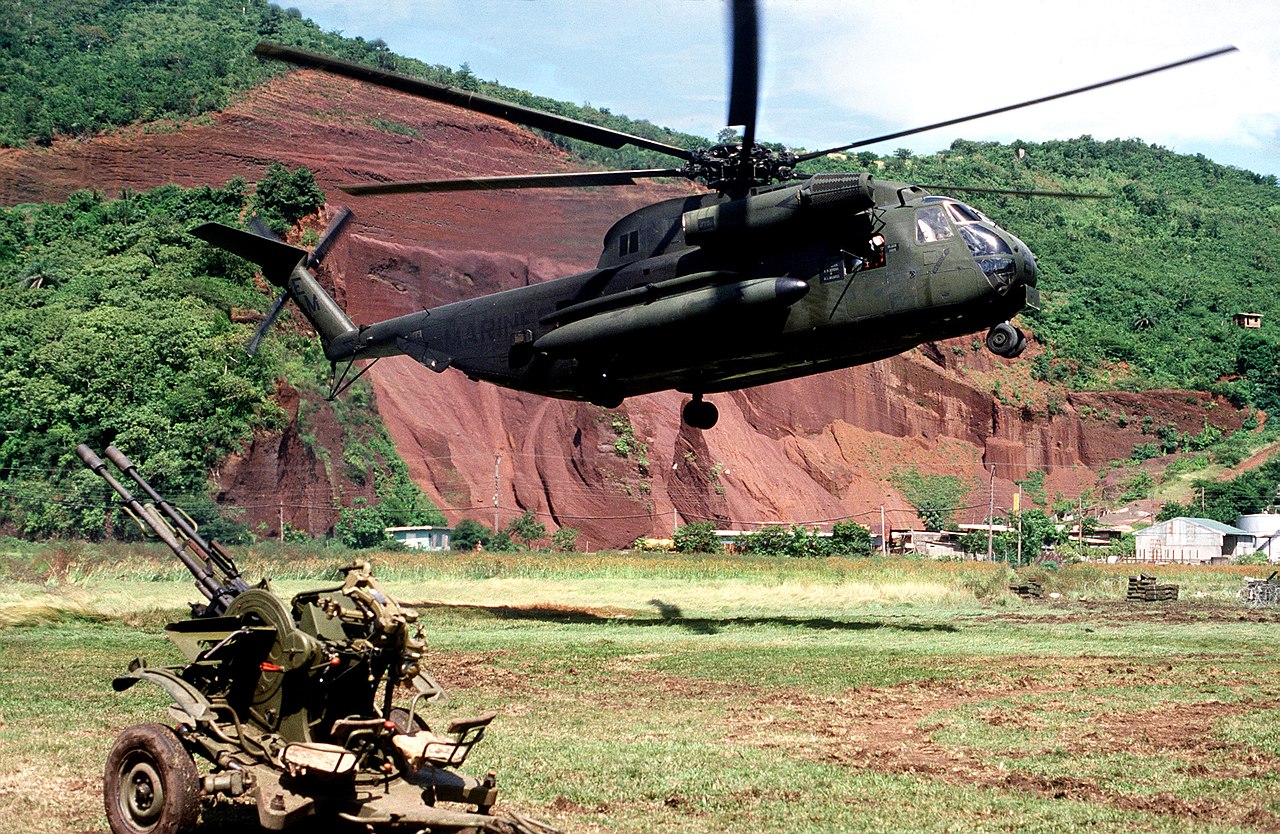
The United States and a coalition of Caribbean countries invaded the island nation of Grenada at dawn on 25 October 1983. It was codenamed Operation Urgent Fury by the U . military, and resulted in military occupation within a few days. It was triggered by strife within the People's Revolutionary Government, which led to the house arrest and execution of the previous leader and second Prime Minister of Grenada, Maurice Bishop, and to the establishment of the Revolutionary Military Council, with Hudson Austin as chairman. Following the invasion there was an interim government appointed, and then general elections held in December 1984. The invasion drew criticism from many countries. British Prime Minister Margaret Thatcher privately disapproved of the mission, in part because she was not consulted in advance and was given very short notice of the military operation, despite Grenada being a member of the Commonwealth, with Queen Elizabeth II as its head of state. However she supported the invasion in public. On October 28, 1983, three days after the invasion, the U . Security Council by a vote of 11 to one failed to pass a resolution "deeply deploring" the invasion, calling it a "flagrant violation of international law" (the United States vetoed the resolution). The United Nations General Assembly condemned it as "a flagrant violation of international law" on 2 November 1983, by a vote of 108 to 9. The invading force consisted of the 1st and 2nd battalions of the U . Army's 75th Ranger Regiment, the 82nd Airborne Division, and elements of the former Rapid Deployment Force, U . Marines, U . Army Delta Force, Navy SEALs, and a small group Air Force TACPs from the 21st TASS Shaw AFB ancillary forces, totaling 7,600 troops, together with Jamaican forces and troops of the Regional Security System (RSS). The invaders quickly defeated Grenadian resistance after a low-altitude assault by the Rangers and 82nd Airborne at Point Salines Airport on the island's south end, and a Marine helicopter and amphibious landing at Pearls Airport on the north end. Austin's military government was deposed. An advisory council was designated by Sir Paul Scoon, Governor-General of Grenada, to administer the government until the 1984 elections. The invasion date of 25 October is now a national holiday in Grenada, called Thanksgiving Day, commemorating the freeing of several political prisoners who were subsequently elected to office. A truth and reconciliation commission was launched in 2001 to re-examine some of the controversies of that tumultuous period in the 1980s; in particular, the commission made an unsuccessful attempt to locate the remains of Maurice Bishop's body, which had been disposed of at Austin's order and never found. The invasion exposed communication and coordination problems between the different branches of the U . military when operating together as a joint force. This triggered post-action investigations resulting in sweeping operational changes in the form of the Goldwater–Nichols Department of Defense Reorganization Act.