
Topzle Topzle

Slave states and free states

Updated: Wikipedia source
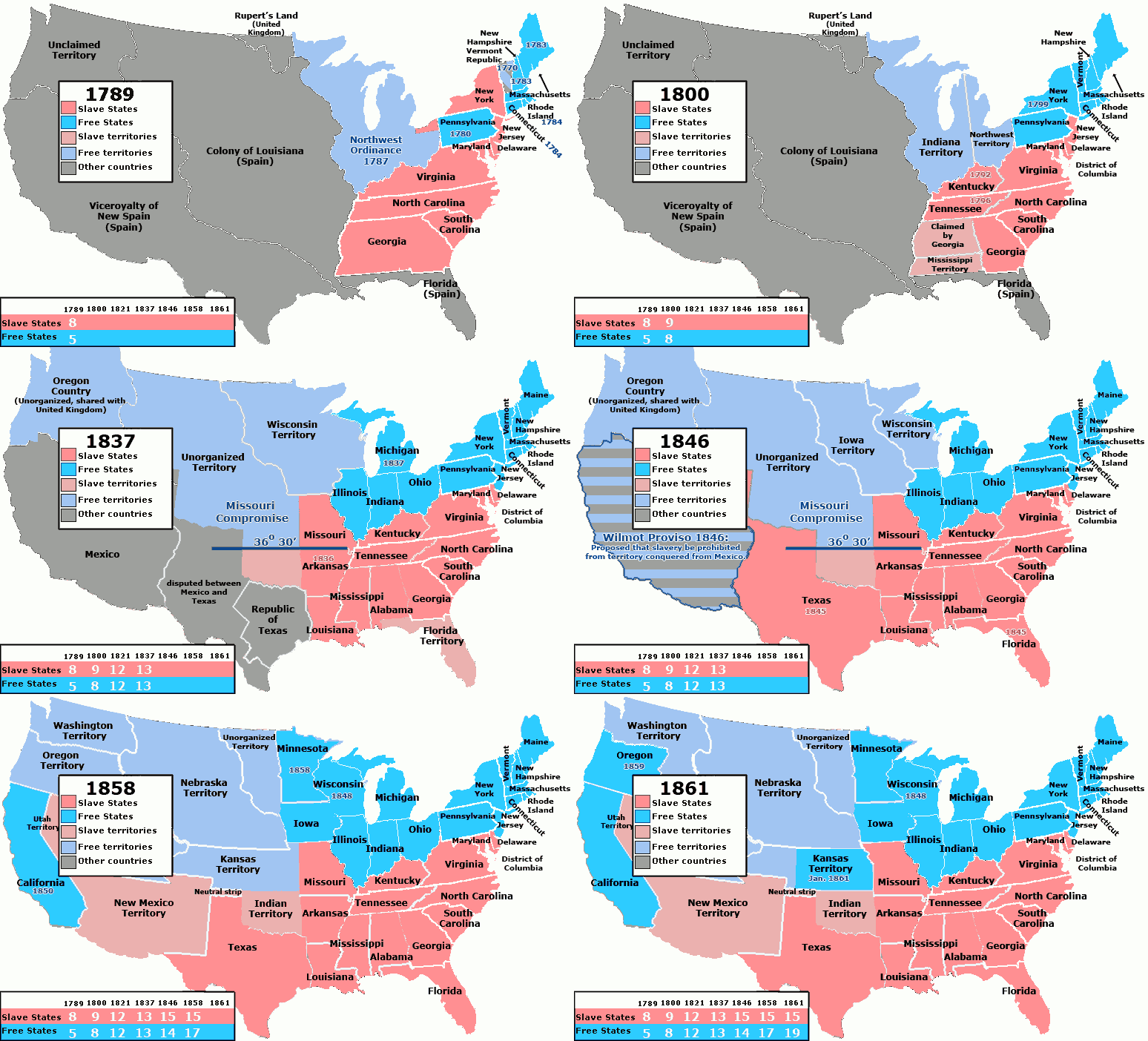
Slave states and free states

In the United States before 1865, a free state was a state in which slavery and the internal or domestic slave trade were prohibited, while a slave state was one in which they were legal. Between 1812 and 1850, it was considered by the slave states to be politically imperative that the number of free states not exceed the number of slave states, so new states were admitted in slave–free pairs. There were, nonetheless, some slaves in most free states up to the 1840 census, and the Fugitive Slave Clause of the U.S. Constitution, as implemented by the Fugitive Slave Act of 1793 and the Fugitive Slave Act of 1850, provided that a slave did not become free by entering a free state and must be returned to their owner. Enforcement of these laws became one of the controversies that arose between slave and free states. By the 18th century, slavery was legal throughout the Thirteen Colonies, but at the time of the American Revolution, rebel colonies started to abolish the practice. Pennsylvania abolished slavery in 1780, and about half the states had abolished slavery by the end of the Revolutionary War or in the first decades of the new country's existence, although, depending on the jurisdiction, this did not mean that all slaves became immediately free due to gradual abolition. Vermont — having declared its independence from Britain in 1777 and thus not being one of the Thirteen Colonies — banned slavery in the same year, before being admitted as a state in 1791. Slavery was a divisive issue in the United States. It was a major issue during the writing of the U.S. Constitution in 1787, the subject of political crises in the Missouri Compromise of 1820 and the Compromise of 1850, and it was the primary cause of the American Civil War in 1861. Just before the Civil War, there were 19 free states and 15 slave states. The most recent free state, Kansas, had entered the Union after its own years-long bloody fight over slavery. During the war, slavery was abolished in some of the slave states, and the Thirteenth Amendment to the United States Constitution, ratified in December 1865, abolished chattel slavery throughout the United States.

Tables

· History › New Territories › Slave and free state pairs
Delaware
Delaware
Slave States
Delaware
Statehood
1787
1860, # and % of population in slaves
1,798 – 1.6%
Free States
New Jersey
Statehood
1787
Free state immediate or gradual abolition and 1860 %
1804–65 – 0.01%
Georgia
Georgia
Slave States
Georgia
Statehood
1788
1860, # and % of population in slaves
462,198 – 43.7%
Free States
Pennsylvania
Statehood
1787
Free state immediate or gradual abolition and 1860 %
1780–1840s – 0%
Maryland
Maryland
Slave States
Maryland
Statehood
1788
1860, # and % of population in slaves
87,189 – 12.7%
Free States
Connecticut
Statehood
1788
Free state immediate or gradual abolition and 1860 %
1784–1840s – 0%
South Carolina
South Carolina
Slave States
South Carolina
Statehood
1788
1860, # and % of population in slaves
402,406 – 57.2%
Free States
Massachusetts
Statehood
1788
Free state immediate or gradual abolition and 1860 %
Free 1783 – 0%
Virginia
Virginia
Slave States
Virginia
Statehood
1788
1860, # and % of population in slaves
490,865 – 30.7%
Free States
New Hampshire
Statehood
1788
Free state immediate or gradual abolition and 1860 %
1783–1800, Free 1857 – 0%
North Carolina
North Carolina
Slave States
North Carolina
Statehood
1789
1860, # and % of population in slaves
331,059 – 33.4%
Free States
New York
Statehood
1788
Free state immediate or gradual abolition and 1860 %
1799–1840s – 0%
Kentucky
Kentucky
Slave States
Kentucky
Statehood
1792
1860, # and % of population in slaves
225,483 – 19.5%
Free States
Rhode Island
Statehood
1790
Free state immediate or gradual abolition and 1860 %
1784–1840s – 0%
Tennessee
Tennessee
Slave States
Tennessee
Statehood
1796
1860, # and % of population in slaves
275,719 – 24.8%
Free States
Vermont
Statehood
1791
Free state immediate or gradual abolition and 1860 %
Free 1777 – 0%
Louisiana
Louisiana
Slave States
Louisiana
Statehood
1812
1860, # and % of population in slaves
331,726 – 46.9%
Free States
Ohio
Statehood
1803
Free state immediate or gradual abolition and 1860 %
Free 1787 – 0%
Slave States
Statehood
1860, # and % of population in slaves
Free States
Statehood
Free state immediate or gradual abolition and 1860 %
Delaware
1787
1,798 – 1.6%
New Jersey
1787
1804–65 – 0.01%
Georgia
1788
462,198 – 43.7%
Pennsylvania
1787
1780–1840s – 0%
Maryland
1788
87,189 – 12.7%
Connecticut
1788
1784–1840s – 0%
South Carolina
1788
402,406 – 57.2%
Massachusetts
1788
Free 1783 – 0%
Virginia
1788
490,865 – 30.7%
New Hampshire
1788
1783–1800, Free 1857 – 0%
North Carolina
1789
331,059 – 33.4%
New York
1788
1799–1840s – 0%
Kentucky
1792
225,483 – 19.5%
Rhode Island
1790
1784–1840s – 0%
Tennessee
1796
275,719 – 24.8%
Vermont
1791
Free 1777 – 0%
Louisiana
1812
331,726 – 46.9%
Ohio
1803
Free 1787 – 0%
· History › New Territories › Slave and free state pairs
Mississippi
Mississippi
Slave states
Mississippi
Year
1817
Free states
Indiana
Year
1816
Alabama
Alabama
Slave states
Alabama
Year
1819
Free states
Illinois
Year
1818
Missouri
Missouri
Slave states
Missouri
Year
1821
Free states
Maine
Year
1820
Arkansas
Arkansas
Slave states
Arkansas
Year
1836
Free states
Michigan
Year
1837
Florida
Florida
Slave states
Florida
Year
1845
Free states
Iowa
Year
1846
Texas
Texas
Slave states
Texas
Year
1845
Free states
Wisconsin
Year
1848
Slave states
Year
Free states
Year
Mississippi
1817
Indiana
1816
Alabama
1819
Illinois
1818
Missouri
1821
Maine
1820
Arkansas
1836
Michigan
1837
Florida
1845
Iowa
1846
Texas
1845
Wisconsin
1848
· History › New Territories › Slave and free state pairs
Slave states
Year
Free states
Year
California
1850
Minnesota
1858
Oregon
1859
Kansas
1861
· History › New Territories › Civil War
West Virginia(gradual abolition plan)
Slave state
West Virginia(gradual abolition plan)
Year
1863
Free state
Nevada
Year
1864
Slave state
Year
Free state
Year
West Virginia(gradual abolition plan)
1863
Nevada
1864

References

  1. 64 Parishes
    https://64parishes.org/entry/domestic-slave-trade
  2. Creating Black Americans: African-American history and its meanings, 1619 to the present
    https://search.worldcat.org/oclc/57722517
  3. Betty Wood, Slavery in Colonial America, 1619–1776 (2013) excerpt and text search
    https://www.amazon.com/Slavery-Colonial-1619-1776-American-ebook/dp/B00C0WEEUS/
  4. Creating Black Americans: African-American History and Its Meanings, 1619 to the Present
    https://archive.org/details/creatingblackame00pain
  5. nationalhumanitiescenter.org
    https://nationalhumanitiescenter.org/pds/livingrev/equality/equality.htm
  6. The Fiery Trial: Abraham Lincoln and American Slavery
    https://www.google.com/books/edition/The_Fiery_Trial_Abraham_Lincoln_and_Amer/earytjxi6pEC?gbpv=1
  7. Wilson, Black Codes (1965), p. 15. "By 1775, inspired by those 'self-evident' truths which were to be expressed by the D
  8. William W. Freehling. The Road to Disunion, Volume II: Secessionists Triumphant, 1854–1861. Oxford University Press, 200
  9. Yankee 'Blackbirding': The United States and the Illegal Transatlantic Slave Trade, 1850-1867
    https://jhir.library.jhu.edu/handle/1774.2/60880
  10. Rael, Patrick. "A Compact for the Good of America? Slavery and the Three-Fifths Compromise"
    https://www.aaihs.org/a-compact-for-the-good-of-america-slavery-and-the-three-fifths-compromise/
  11. History of the Ordinance of 1787 and the Old Northwest Territory A Supplemental Text for School Use
    https://www.gutenberg.org/cache/epub/61909/pg61909-images.html
  12. PBS
    https://web.archive.org/web/20040528221504/http://www.pbs.org/ktca/liberty/popup_northwest.html
  13. Journal of the Early Republic
    https://muse.jhu.edu/article/649287/pdf
  14. Michael A. Morrison, "Westward the Curse of Empire: Texas Annexation and the American Whig Party". Journal of the Early
    https://www.jstor.org/stable/3123558
  15. Michael E. Woods, "The Compromise of 1850 and the Search for a Usable Past." Journal of the Civil War Era 9.3 (2019): 43
  16. McPherson, James M. Battle Cry of Freedom: The Civil War Era. Oxford University Press, 2003. p. 105
  17. Nicole Etcheson. Bleeding Kansas: Contested Liberty in the Civil War Era. Lawrence, Kansas: University Press of Kansas,
  18. Leonard L. Richards, The Slave Power: The Free North and Southern Domination, 1780–1860 (LSU Press, 2000).
  19. Statistics of the United States
    https://www2.census.gov/library/publications/decennial/1850/1850c/1850c-04.pdf
  20. Negro Population in the United States, 1790–1915
    https://archive.org/details/americannegrohis0000unse_d4r3/page/56/mode/2up
  21. James Oakes, Freedom National: The Destruction of Slavery in the United States, 1861–1865, W. W. Norton, 2012, pp. 296–2
  22. wvculture.org
    http://www.wvculture.org/history/statehood/statehood15.html
  23. virginia.edu
    http://mapserver.lib.virginia.edu/index.html
  24. wvculture.org
    https://web.archive.org/web/20170814022336/http://www.wvculture.org/history/statehood/willeyamendment.html
  25. Alton Hornsby Jr., Black America: A State-by-State Historical Encyclopedia, Greenwood, 2011, vol. 2, p. 922.
  26. wvculture.org
    https://web.archive.org/web/20070307001222/http://www.wvculture.org/history/statehoo.html
  27. wvculture.org
    https://web.archive.org/web/20131231191446/http://www.wvculture.org/history/blachist.html
  28. wvculture.org
    https://web.archive.org/web/20141008170544/http://www.wvculture.org/history/thisdayinwvhistory/0203.html
  29. emancipation.dc.gov
    https://emancipation.dc.gov/page/ending-slavery-district-columbia
  30. www.nps.gov
    https://www.nps.gov/articles/000/emancipation-in-washington-dc.htm
  31. The Mormons: Or, Latter-day Saints, in the Valley of the Great Salt Lake: a History of Their Rise and Progress, Peculiar Doctrines, Present Condition, and Prospects, Derived from Personal Observation, During a Residence Among Them
    https://archive.org/details/mormons00gunngoog
  32. We're History
    http://werehistory.org/the-significance-of-june-19th/
  33. Pacific Historical Review
    https://doi.org/10.1525%2Fphr.2004.73.3.349
  34. Native American Netroots
    https://web.archive.org/web/20190413154937/http://nativeamericannetroots.net/diary/1862
  35. Pritzker, Barry. 2000, A Native American Encyclopedia: History, Culture, and Peoples. Oxford University Press, p. 114.
  36. JPR Jefferson Public Radio
    https://web.archive.org/web/20191114111002/https://www.ijpr.org/post/norcal-native-writes-california-genocide
  37. Pacific Historical Review
    https://doi.org/10.1525/phr.2012.81.2.155
  38. The Historical Atlas of the Congresses of the Confederate States of America, 1861–1865
  39. Virginia: The New Dominion, a History from 1607 to the Present
  40. Eleven states had seceded, but Tennessee was under Union control.
    https://www.nps.gov/anjo/learn/historyculture/johnson-and-tn-emancipation.htm#:~:text=On%20January%201%2C%201863%2C%20Abraham,was%20serving%20as%20Military%20Governor.
  41. Reconstruction: A Concise History
    https://search.worldcat.org/oclc/999309004
  42. American Memory "Abolition in the District of Columbia", Today in History, Library of Congress, viewed December 15, 2014
    http://memory.loc.gov/ammem/today/apr16.html
  43. History of West Virginia: in two parts
    https://archive.org/details/historyofwestvir00lewi/page/380/mode/2up?q=permanent+residence&view=theater
  44. West Virginia Legislature, House Concurrent Resolution 49, March 15, 2021
    https://www.wvlegislature.gov/Bill_Status/bills_text.cfm?billdoc=hcr49%20intr.htm&yr=2021&sesstype=RS&i=49&houseorig=H&billtype=CR
  45. "The Abolition of Slavery in Virginia"
    https://encyclopediavirginia.org/entries/the-abolition-of-slavery-in-virginia/
  46. edu.lva.virginia.gov
    https://web.archive.org/web/20160330062222/http://edu.lva.virginia.gov/online_classroom/shaping_the_constitution/doc/convention
  47. www.freedmen.umd.edu
    http://www.freedmen.umd.edu/chronol.htm
  48. "Reconstruction: A State Divided"
    https://www.crt.state.la.us/louisiana-state-museum/online-exhibits/the-cabildo/reconstruction-a-state-divided/index
  49. "Archives of Maryland Historical List: Constitutional Convention, 1864"
    http://www.msa.md.gov/msa/speccol/sc2600/sc2685/html/conv1864.html
  50. "Missouri abolishes slavery"
    https://web.archive.org/web/20120425132518/http://www.civilwaronthewesternborder.org/event/missouri-abolishes-slavery
  51. Report of the Joint Committee on Reconstruction, at the first session, Thirty-ninth Congress
    https://books.google.com/books?id=dUgWAAAAYAAJ&pg=PA10
  52. Slavenorth.com
    http://www.slavenorth.com/delaware.htm
  53. A New History of Kentucky
    https://books.google.com/books?id=FdTIIEZ1k2QC&q=kentucky+abolishes+slavery&pg=PA174
  54. Encyclopedia.com
    https://www.encyclopedia.com/humanities/applied-and-social-sciences-magazines/slavery-middle-states-nj-ny-pa
  55. Princeton & Slavery
    https://slavery.princeton.edu/stories/legislating-slavery-in-new-jersey
  56. Kentucky.com
    https://web.archive.org/web/20180702150756/https://www.kentucky.com/news/hot-topics/article44405460.html
Image
Source:
Tip: Wheel or +/− to zoom, drag to pan, Esc to close.