
Sher Bahadur Deuba
Updated: Wikipedia source
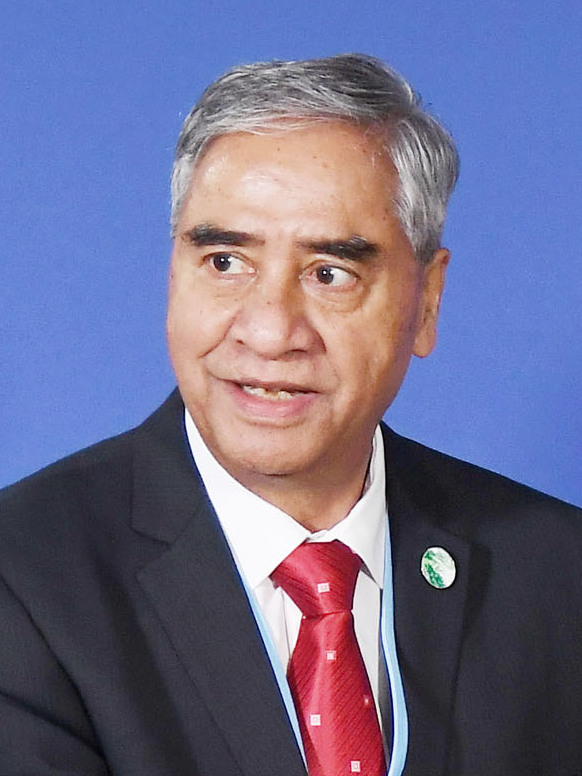
Sher Bahadur Deuba (born 13 June 1946) is a Nepalese politician who served as the 32nd prime minister of Nepal for five terms (1995–1997, 2001–2002, 2004–2005, 2017–2018 and 2021–2022). He was the president of the Nepali Congress since 2016 until 2026 and was the Member of Parliament for the parliamentary constituency of Dadeldhura 1 before the parliament was dissolved on 12 September 2025. During the Gen Z protests, he and his wife, Arzu Rana Deuba, were physically assaulted by protesters at their residence. His tenure in office has been controversial for nepotism, corruption and disillusionment with citizens. Born and raised in Ashigram, a remote village in Ganyapdhura Rural Municipality of Dadeldhura, Deuba completed his primary education there and his secondary education in Doti. He completed his higher education at Tri-Chandra College In 1991, he was elected to the House of Representatives and served as the Minister of Home Affairs in the cabinet led by Girija Prasad Koirala. Deuba became prime minister after Man Mohan Adhikari tried to dissolve the parliament for the second time in two years in 1995. He oversaw the signature of the Mahakali treaty with India during his first term. His second premiership started in July 2001 amidst the rise of the Maoists and he later declared a state of emergency and listed the Communist Party of Nepal (Maoist) as a "terrorist organization". He was dismissed by King Gyanendra in October 2002, but after a public backlash, he was reappointed prime minister in June 2004. He was arrested after the 2005 coup d'état by King Gyanendra, and released in February 2006 after the Supreme Court declared his arrest unlawful. Deuba was sworn in as prime minister for a fourth stint in June 2017, as per an agreement to form a rotational government by Congress and the CPN (Maoist Centre). His government successfully conducted the elections of all three levels of government in different phases in 2017. On 12 July 2021, the Supreme Court ordered the appointment of Deuba as prime minister within 28 hours, and he was appointed prime minister for a fifth term by President Bidya Devi Bhandari in accordance with Article 76(5) of the Constitution of Nepal the next day.