
Topzle Topzle

Saturation diving

Updated: Wikipedia source
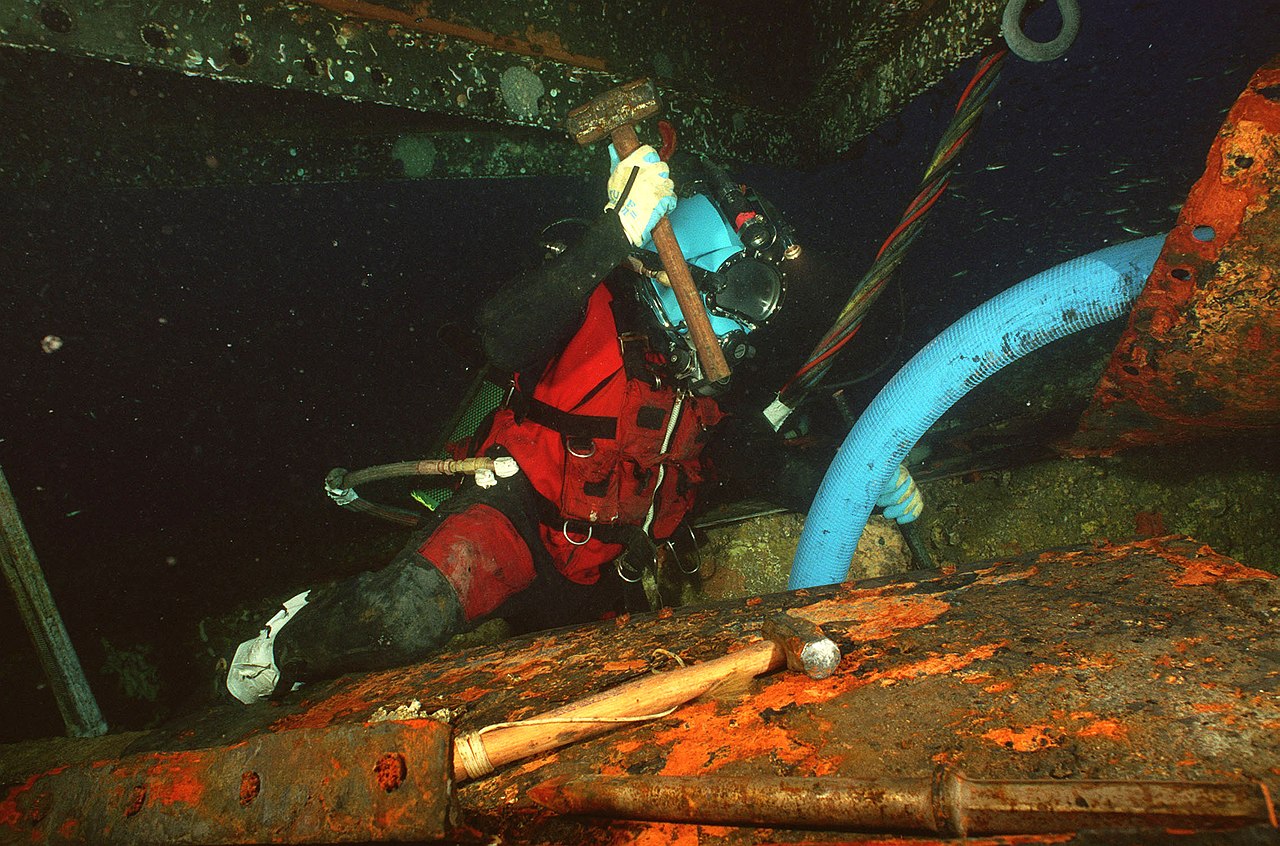
Saturation diving

Saturation diving is an ambient pressure diving technique which allows a diver to remain at working depth for extended periods during which the body tissues become saturated with metabolically inert gas from the breathing gas mixture. Once saturated, the time required for decompression to surface pressure will not increase with longer exposure. The diver undergoes a single decompression to surface pressure at the end of the exposure of several days to weeks duration. The ratio of productive working time at depth to unproductive decompression time is thereby increased, and the health risk to the diver incurred by decompression is minimised. Unlike other ambient pressure diving, the saturation diver is only exposed to external ambient pressure while at diving depth. The extreme exposures common in saturation diving make the physiological effects of ambient pressure diving more pronounced, and they tend to have more significant effects on the divers' safety, health, and general well-being. Several short and long term physiological effects of ambient pressure diving must be managed, including decompression stress, high pressure nervous syndrome (HPNS), compression arthralgia, dysbaric osteonecrosis, oxygen toxicity, inert gas narcosis, high work of breathing, and disruption of thermal balance. Most saturation diving procedures are common to all surface-supplied diving, but there are some which are specific to the use of a closed bell, the restrictions of excursion limits, and the use of saturation decompression. Surface saturation systems transport the divers to the worksite in a closed bell, use surface-supplied diving equipment, and are usually installed on an offshore platform or dynamically positioned diving support vessel. Divers operating from underwater habitats may use surface-supplied equipment from the habitat or scuba equipment, and access the water through a wet porch, but will usually have to surface in a closed bell, unless the habitat includes a decompression chamber. The life support systems provide breathing gas, climate control, and sanitation for the personnel under pressure, in the accommodation and in the bell and the water. There are also communications, fire suppression and other emergency services. Bell services are provided via the bell umbilical and distributed to divers through excursion umbilicals. Life support systems for emergency evacuation are independent of the accommodation system as they must travel with the evacuation module. Saturation diving is a specialized mode of diving; of the 3,300 commercial divers employed in the United States in 2015, 336 were saturation divers. Special training and certification is required, as the activity is inherently hazardous, and a set of standard operating procedures, emergency procedures, and a range of specialised equipment is used to control the risk, that require consistently correct performance by all the members of an extended diving team. The combination of relatively large skilled personnel requirements, complex engineering, and bulky, heavy equipment required to support a saturation diving project make it an expensive diving mode, but it allows direct human intervention at places that would not otherwise be practical, and where it is applied, it is generally more economically viable than other options, if such exist.

Tables

US Navy heliox saturation decompression table[1] · Operating procedures › Decompression from saturation
1600 to 200 fsw (488 to 61 msw)
Depth
1600 to 200 fsw (488 to 61 msw)
Ascent rate
6 fsw (1.83 msw) per hour
200 to 100 fsw (61 to 30 msw)
Depth
200 to 100 fsw (61 to 30 msw)
Ascent rate
5 fsw (1.52 msw) per hour
100 to 50 fsw (30 to 15 msw)
Depth
100 to 50 fsw (30 to 15 msw)
Ascent rate
4 fsw (1.22 msw) per hour
50 to 0 fsw (15 to 0 msw)
Depth
50 to 0 fsw (15 to 0 msw)
Ascent rate
3 fsw (0.91 msw) per hour
Depth
Ascent rate
1600 to 200 fsw (488 to 61 msw)
6 fsw (1.83 msw) per hour
200 to 100 fsw (61 to 30 msw)
5 fsw (1.52 msw) per hour
100 to 50 fsw (30 to 15 msw)
4 fsw (1.22 msw) per hour
50 to 0 fsw (15 to 0 msw)
3 fsw (0.91 msw) per hour

References

  1. US Navy Diving Manual, 6th revision
    https://web.archive.org/web/20080502023541/http://www.supsalv.org/00c3_publications.asp?destPage=00c3&pageId=3.9
  2. 2023-69
    https://www.havtil.no/contentassets/04882bf9c4054c0989f0fd70fc8c05e6/2022_1121-prosjektrapport-compression-and-excursion-parameters-for-saturation-diving.pdf
  3. Commercial Diving: Surface-Mixed Gas, Sur-D-O2, Bell Bounce, Saturation
  4. Scubadoc's Diving Medicine Online
    http://www.scuba-doc.com/cmprarth.html
  5. Diving Hyperb. Med
    https://www.ncbi.nlm.nih.gov/pmc/articles/PMC11065503
  6. US Navy Diving Manual, 6th revision
    https://web.archive.org/web/20080502023541/http://www.supsalv.org/00c3_publications.asp?destPage=00c3&pageId=3.9
  7. Developments in CO2 monitoring
    https://gue.tv/programs/co2-monitoring-ccr-rebreather-diving-safety
  8. www.tdisdi.com
    https://www.tdisdi.com/tdi-diver-news/is-helium-a-cold-gas/
  9. Living and Working in the Sea
  10. Offshore Installation Practice
  11. Guidance on Hyperbaric Evacuation Systems IMCA D052
    http://www.fathomsystems.co.uk/assets/Files/imcad052.pdf
  12. Class II Training Standard
  13. www.bls.gov
    https://www.bls.gov/oes/current/oes499092.htm
  14. Federal Register
    https://www.federalregister.gov/documents/2015/02/19/2015-02714/commercial-diving-operations
  15. www.professionaldivingcentre.com
    http://www.professionaldivingcentre.com/6-man-saturation-system/
  16. www.slideserve.com
    https://www.slideserve.com/lalya/the-economics-of-saturation-diving-systems-costs-and-benefits
  17. Diving Medicine
  18. Living and working in the sea
  19. Medical Clinics of North America
    https://doi.org/10.1016%2FS0025-7125%2816%2936438-0
  20. Faceplate
    https://web.archive.org/web/20120207231048/http://www.supsalv.org/pdf/faceplatefebruary2005.pdf
  21. Pressure, Newsletter of the Undersea and Hyperbaric Medical Society
    https://search.worldcat.org/issn/0889-0242
  22. www.cousteau.org
    https://www.cousteau.org/legacy/technology/conshelf/
  23. The Atlantis Series and Other Deep Dives
  24. Diving Deeper into SCUBA... Science: Practical and Theoretical Knowledge
  25. North Sea Divers
    https://lescompagnonsdusaga.files.wordpress.com/2019/05/northseadivers.pdf
  26. Journal of the Royal Society of Medicine
    https://www.ncbi.nlm.nih.gov/pmc/articles/PMC1289835
  27. www.jfdglobal.com
    https://www.jfdglobal.com/files/3016/7688/2376/JFD_HMS_Edinburgh.pdf
  28. New Scientist
    https://www.newscientist.com/article/mg13618493.000-technology-dry-run-for-deepest-dive-.html
  29. Guidance
    http://www.hse.gov.uk/diving/carr.htm
  30. NOAA Diving Manual, Diving for Science and Technology
  31. FirstScience.com
    https://web.archive.org/web/20100126025114/http://www.firstscience.com/home/perspectives/editorials/living-underwater_21248.html
  32. www.ncbi.nlm.nih.gov
    https://www.ncbi.nlm.nih.gov/books/NBK470454/
  33. Bennett and Elliott's physiology and medicine of diving
  34. Bennett & Rostain (2003), p. 305.
  35. "Relative narcotic potencies of hydrogen, helium, nitrogen, and their mixtures"
    http://jap.physiology.org/content/29/1/23.extract
  36. Medical Dictionary for the Health Professions and Nursing. S.v. "work of breathing." Retrieved September 8, 2015, from h
    http://medical-dictionary.thefreedictionary.com/work+of+breathing
  37. www.youtube.com
    https://www.youtube.com/watch?v=QBajM3xmOtc
  38. Respiratory Physiology of Rebreather Diving
    https://www.omao.noaa.gov/sites/default/files/documents/Rebreathers%20and%20Scientific%20Diving%20Proceedings%202016.pdf
  39. Bennett and Elliott's physiology and medicine of diving
  40. Techniques for Diving Deeper than 1,500 feet
  41. "Diving With Gas Mixes Other Than Air"
    http://www-personal.umich.edu/~lpt/mixhistory.htm
  42. Undersea Biomedical Research
  43. Bennett and Elliott's physiology and medicine of diving
  44. Undersea and Hyperbaric Medicine
    https://search.worldcat.org/issn/1066-2936
  45. Lancet
    https://doi.org/10.1016%2Fs0140-6736%2881%2990831-x
  46. Med Hypotheses
    https://doi.org/10.1054%2Fmehy.1999.0901
  47. PLOS ONE
    https://www.ncbi.nlm.nih.gov/pmc/articles/PMC4482426
  48. DMAC 04 revision 2
  49. DMAC 04
  50. "Saturation Diving"
    https://dan.org/alert-diver/article/saturation-diving/
  51. Reduced pulmonary function in saturation divers correlates with diving exposure
  52. "Dysbaric Osteonecrosis"
    https://www.ncbi.nlm.nih.gov/books/NBK482310/
  53. Growth of Pseudomonas aeruginosa in an heliox atmosphere
  54. Frontiers in Psychology
    https://www.ncbi.nlm.nih.gov/pmc/articles/PMC6340096
  55. Extreme Physiology & Medicine
    https://www.ncbi.nlm.nih.gov/pmc/articles/PMC4704397
  56. Class II Training Standard
  57. Class III Training Standard
  58. An Underwater Augmented Reality system for commercial diving operations
    https://doi.org/10.23919%2FOCEANS.2009.5422365
  59. Guidance for diving supervisors IMCA D 022
  60. www.jfdglobal.com
    https://www.jfdglobal.com/media/case-studies/technip-24-man-saturation-system/
  61. "Under Pressure: Perils of the deep"
    https://www.kongsberg.com/maritime/feature_articles/2013/5/perils-of-the-deep/
  62. NORSOK U-100:2014, Manned underwater operations
    https://law.resource.org/pub/us/cfr/regulations.gov.docket.08/USCG-1998-3786-0118.pdf
  63. Diving Hyperb Med
    https://www.ncbi.nlm.nih.gov/pmc/articles/PMC8313767
  64. www.shelfsubsea.com
    https://www.shelfsubsea.com/asset/saturation-and-air-diving-systems/
  65. www.dmac-diving.org
    https://www.dmac-diving.org/guidance/DMAC26.pdf
  66. Saturation Diving Manual
  67. The Professional Divers's Handbook
  68. IMCA D 014 Rev. 3.3
    https://www.imca-int.com/resources/technical-library/document/134b165f-c55b-ee11-8def-6045bdd2c9bc/)/media/70842/imcad014.pdf
  69. Saturation diving handbook: Book 3 of 4 - Bell procedures
    https://www.diving-rov-specialists.com/index_htm_files/sat-manual-book-3.pdf&ved=2ahUKEwi8iryMzKuRAxV5U0EAHXfpAcUQFnoECBgQAQ&usg=AOvVaw19s28y4AIsN9Oz29FpkYFB
  70. "Bell Run and Bell Lock-Out Times, and Bell Run Times in Relation to Habitats"
    https://www.hse.gov.uk/pubns/dvis7.htm
  71. Safety Flash IMCA SF 09/17
    https://www.imca-int.com/resources/safety/safety-flashes/0917-diving-bell-tup-o-ring-seal-damage/
  72. Research report 244
    http://www.hse.gov.uk/research/rrpdf/rr244.pdf
  73. Journal of Applied Physiology
    https://doi.org/10.1152%2Fjapplphysiol.00121.2022
  74. Report4-89
    https://diving-rov-specialists.com/index_htm_files/scient-b_21-testing-saturation-excusions%20usn-thalman.pdf
  75. Undersea Biomedical Research
    https://pubmed.ncbi.nlm.nih.gov/10897865
  76. Diving and Hyperbaric Medicine
    https://www.ncbi.nlm.nih.gov/pmc/articles/PMC9767825
  77. Report of a Workshop held on 13 April 2011 in London, UK
    https://www.dmac-diving.org/guidance/DMAC-Workshop-20110413.pdf
  78. DMAC 21 Rev. 2
    https://www.dmac-diving.org/guidance/DMAC21.pdf
  79. Offshore Technology Conference
    http://www.onepetro.org/mslib/servlet/onepetropreview?id=OTC-6073-MS
  80. "Extreme Environment Engineering Departement Hyperbaric Experimental Centre – History"
    https://web.archive.org/web/20081005073910/http://www.comex.fr/suite/ceh/histo/histo%20anglais.html
  81. New Scientist
    https://www.newscientist.com/article/mg13618414-100-technology-hydrogen-helps-divers-take-a-deep-breath/
  82. "The origins of deep sea diving in Brazil"
    http://www.scubarec.com.br/index_arquivos/Historia.htm
  83. Undersea and Hyperbaric Medicine
    https://pubmed.ncbi.nlm.nih.gov/7742710
  84. "HYDRA 8 and HYDRA 10 test projects"
    https://web.archive.org/web/20090105233813/http://www.comex.fr/suite/ceh/histo/histo%20anglais.html
  85. CEH/D01064-rev.9/R&D-VL-E-25/02/2004
    https://web.archive.org/web/20071013071223/http://www.comex.fr/suite/ceh/histo/historique%20CEH%20anglais.pdf
  86. "Portrait of Theo Mavrotomos, legend and diving recordman – The CLICK-DIVE Magazine"
    https://magazine.click-dive.com/2019/06/14/portrait-of-theo-mavrotomos-legend-and-diving-recordman/
  87. www.divingheritage.com
    https://www.divingheritage.com/moderncomex.htm
  88. oceanexplorer.noaa.gov
    https://oceanexplorer.noaa.gov/facts/rov.html#:~:text=ROVs%20allow%20us%20to%20investigate,the%20time%20available%20for%20exploration.
  89. IMCA D 050
    https://www.imca-int.com/resources/technical-library/document/a916b95b-c55b-ee11-8def-6045bdd2cf5f/
  90. Code of Practice for Commercial Diver Training, Revision 3
    https://web.archive.org/web/20161107021628/http://www.labour.gov.za/DOL/downloads/documents/useful-documents/occupational-health-and-safety/commercialdive2014.pdf
  91. Front Public Health
    https://www.ncbi.nlm.nih.gov/pmc/articles/PMC9095950
  92. www.offshore-energy.biz
    https://www.offshore-energy.biz/imca-issues-rov-guide-during-diving-ops/
  93. The Independent
    https://www.independent.co.uk/news/long_reads/last-breath-documentary-diving-chris-lemons-north-sea-rescue-a8849036.html
  94. inews.co.uk
    https://inews.co.uk/culture/film/last-breath-film-diver-accident-oxygen/
Image
Source:
Tip: Wheel or +/− to zoom, drag to pan, Esc to close.