
Topzle Topzle

Philippines

Updated: Wikipedia source
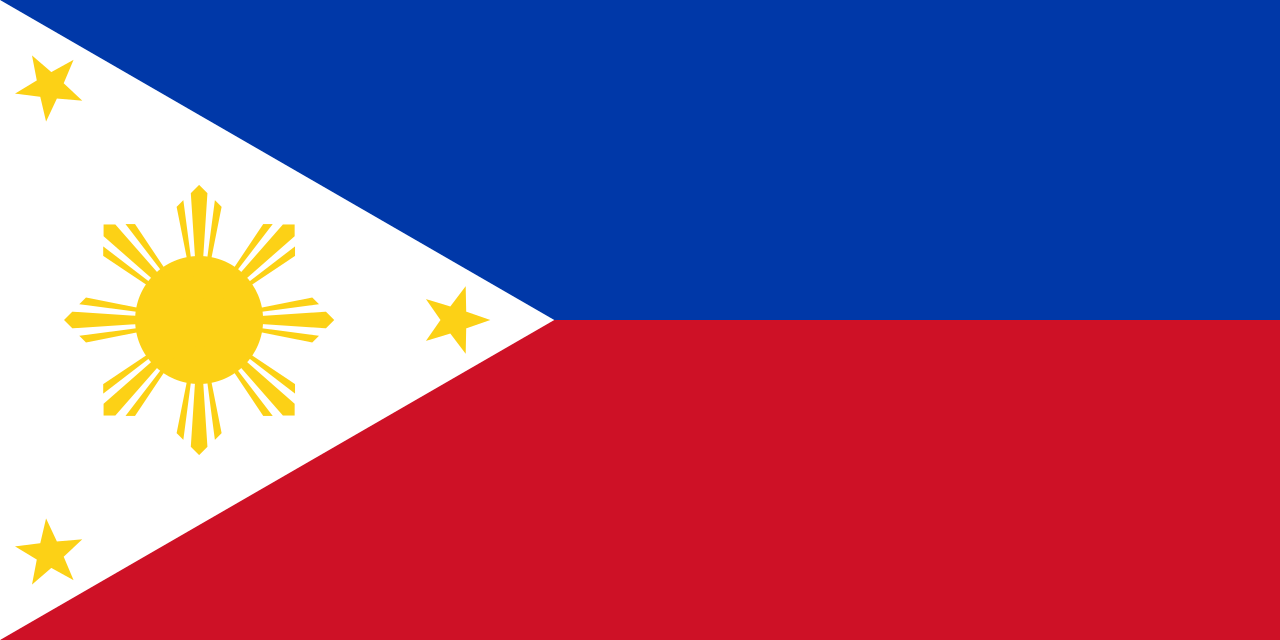
Philippines

The Philippines, officially the Republic of the Philippines, is an archipelagic country in Southeast Asia. Located in the western Pacific Ocean, it consists of about 7,641 islands, with a total area of about 300,000 square kilometers, which are broadly categorized in three main geographical divisions from north to south: Luzon, Visayas, and Mindanao. With a population of over 114 million, it is the world's twelfth-most-populous country. The Philippines is bounded by the South China Sea to the west, the Philippine Sea to the east, and the Celebes Sea to the south. It shares maritime borders with Taiwan to the north, Japan to the northeast, Palau to the east and southeast, Indonesia to the south, Malaysia to the southwest, Vietnam to the west, and China to the northwest. It has diverse ethnicities and a rich culture. Manila is the country's capital, and its most populated city is Quezon City. Both are within Metro Manila. Negritos, the archipelago's earliest inhabitants, were followed by waves of Austronesian peoples. The adoption of animism, Hinduism with Buddhist influence, and Islam established island-kingdoms. Extensive overseas trade with neighbors such as the late Tang or Song empire brought Chinese people to the archipelago as well, which would also gradually settle in and intermix over the centuries. The arrival of the explorer Ferdinand Magellan marked the beginning of Spanish colonization. In 1543, Spanish explorer Ruy López de Villalobos named the archipelago las Islas Filipinas in honor of King Philip II. Catholicism became the dominant religion, and Manila became the western hub of trans-Pacific trade. Hispanic immigrants from Latin America and Iberia would also selectively colonize. The Philippine Revolution began in 1896, and became entwined with the 1898 Spanish–American War. Spain ceded the territory to the United States, and Filipino revolutionaries declared the First Philippine Republic. The ensuing Philippine–American War ended with the United States controlling the territory until the Japanese invasion of the islands during World War II. After the United States retook the Philippines from the Japanese, the Philippines became independent in 1946. Since then, the country notably experienced a period of martial law from 1972 to 1981 under the dictatorship of Ferdinand Marcos and his subsequent overthrow by the People Power Revolution in 1986, returning to democracy. The Philippines is an emerging market and a developing and newly industrialized country, whose economy is transitioning from being agricultural to service- and manufacturing-centered. It has a variety of natural resources and a globally-significant level of biodiversity. The country is also part of multiple international organizations and forums, mainly in ASEAN. Despite its fast economic growth, it continues to struggle with inequality, widespread corruption, and vulnerability to natural disasters due to its location within the Pacific Ring of Fire, and to the equator, making it prone to earthquakes, monsoon rains, and typhoons, to which the Philippines has built a resilience.

Infobox

Capital
Manila 13°N 122°E / 13°N 122°E / 13; 122
Government seat
Metro Manila
Largest city
Quezon City
Official languages
Filipino English
Recognized national languages
Filipino
Recognized regional languages
19 languages
National sign language
Filipino Sign Language
Other recognized languages
Spanish and Arabic
Ethnic groups (2020)
26 % Tagalog 14 % Bisaya 8 % Ilocano 8 % Cebuano 7 % Ilonggo 6 % Bicolano 20 % other
Religion (2020)
85 % Christianity 78 % Catholicism 6 % other Christian 6 % Islam 8 % other
Demonyms
Filipino (neutral) Filipina (feminine) Pinoy (colloquial neutral) Pinay (colloquial feminine) Philippine (adjective for certain common nouns)
Government
Unitary presidential republic
• President
Bongbong Marcos
• Vice President
Sara Duterte
• Senate President
Alan Peter Cayetano
• House Speaker
Bojie Dy
• Chief Justice
Alexander Gesmundo
Legislature
Congress
• Upper house
Senate
• Lower house
House of Representatives
• Declaration
June 12, 1898
• Cession
April 11, 1899
• Self-government
November 15, 1935
• Recognized
July 4, 1946
• Constitution
February 2, 1987
• Total
$512 billion (35th)
• Water (%)
0 (inland waters)
• 2024 census
112,729,484
• Density
363 /km2 (941 /sq mi) (34th)
GDP (PPP)
2026 estimate
• Per capita
$4,443 (125th)
GDP (nominal)
2026 estimate
Gini (2023)
39 medium inequality
HDI (2023)
0 high (117th)
Currency
Philippine peso (₱) (PHP)
Time zone
UTC 8 (PhST)
Calling code
63
ISO 3166 code
PH
Internet TLD
ph

References

  1. Although the Flag and Heraldic Code of the Philippines (Republic Act 8491) passed in 1998 defined modifications to the coat of arms that removed the colonial charges, a referendum legally required to ratify the changes h
  2. While Manila is designated as the nation's capital, the seat of government is the National Capital Region, commonly known as "Metro Manila", of which the city of Manila is a part. Many national government institutions ar
  3. As per the 1987 Constitution: "Spanish and Arabic shall be promoted on a voluntary and optional basis."
  4. Excludes Catholic Charismatics numbering 74,096 persons (0 % of the Philippine household population in 2020)
  5. The actual area of the Philippines is 343,448 km2 (132,606 sq mi) according to some sources.
  6. /ˈfilɪpiːnz/ ⓘ; Filipino: Pilipinas, Tagalog pronunciation: [pɪ ɪˈpiː ɐs]
  7. Filipino: Republika ng Pilipinas. In the recognized regional languages of the Philippines: Aklan: Republika it Pilipinas Bikol: Republika kan Filipinas Cebuano: Republika sa Pilipinas Chavacano: República de Filipina
  8. This is a summary, omitting significant detail. For more detail, see Schurman Commission § Survey visit to the Philippines.
  9. Excludes Catholic Charismatics numbering 74,096 persons (0 % of the Philippine household population in 2020)
  10. In the Philippines, eating with chopsticks is occasionally used, less commonly used, less frequently used, seldom used, very rarely or rarely used, or not very common, but it's perfectly acceptable, especially in certain
  11. Flag and Heraldic Code of the Philippines
    1998
    https://web.archive.org/web/20170525084350/https://www.officialgazette.gov.ph/1998/02/12/republic-act-no-8491/
  12. Establishing Manila as the Capital of the Philippines and as the Permanent Seat of the National Government
    1976
    https://web.archive.org/web/20170525084430/https://www.officialgazette.gov.ph/1976/05/29/presidential-decree-no-940-s-1976/
Image
Source:
Tip: Wheel or +/− to zoom, drag to pan, Esc to close.