
Topzle Topzle

Measles

Updated: Wikipedia source
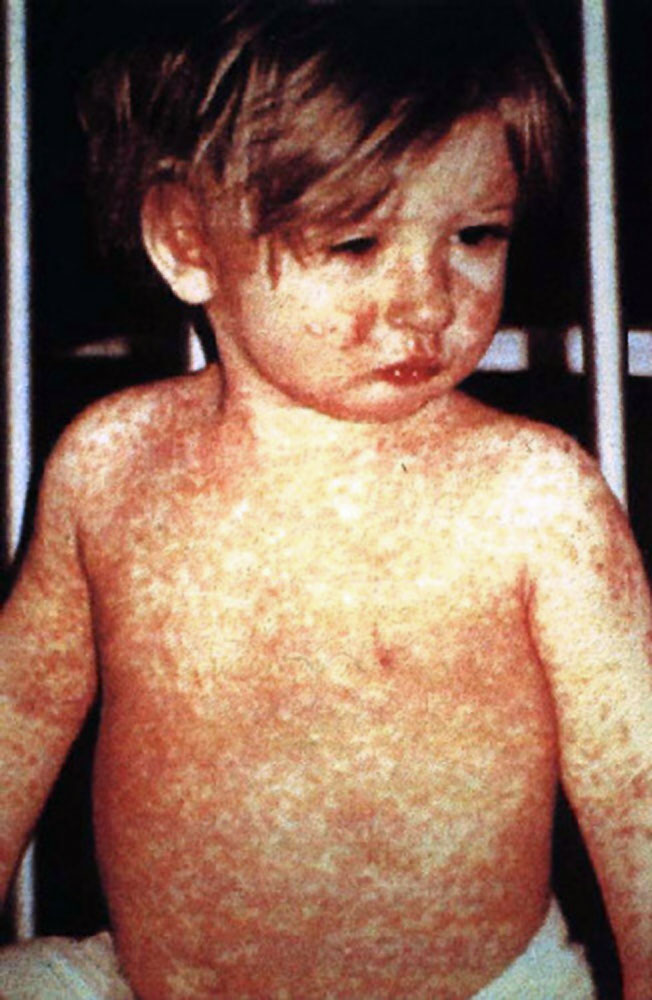
Measles

Measles (probably from Middle Dutch or Middle High German masel(e), meaning "blemish, blood blister") is a highly contagious, vaccine-preventable infectious disease caused by measles virus. Other names include morbilli, rubeola, 9-day measles, red measles, and English measles. Symptoms usually develop 10–12 days after exposure to an infected person and last 7–10 days. Initial symptoms typically include fever, often greater than 40 °C (104 °F), cough, runny nose, and inflamed eyes. Small white spots known as Koplik spots may form inside the mouth two or three days after the start of symptoms. A red, flat rash which usually starts on the face and then spreads to the rest of the body typically begins three to five days after the start of symptoms. Common complications include diarrhea (in 8% of cases), middle ear infection (7%), and pneumonia (6%). These occur in part due to measles-induced immunosuppression. Less commonly, seizures, blindness, or inflammation of the brain may occur. Measles is an airborne disease which spreads easily from one person to the next through the coughs and sneezes of infected people. It may also be spread through direct contact with mouth or nasal secretions. It is extremely contagious: nine out of ten people who are not immune and share living space with an infected person will be infected. Furthermore, measles's reproductive number estimates vary beyond the frequently cited range of 12 to 18, with a 2017 review giving a range of 3 to 203 . People are infectious to others from four days before to four days after the start of the rash. While often regarded as a childhood illness, it can affect people of any age. Most people do not get the disease more than once. Testing for the measles virus in suspected cases is important for public health efforts. Measles is not known to occur in other animals. Once a person has become infected, no specific treatment is available, although supportive care may improve outcomes. Such care may include oral rehydration solution (slightly sweet and salty fluids), healthy food, and medications to control the fever. Antibiotics should be prescribed if secondary bacterial infections such as ear infections or pneumonia occur. Vitamin A supplementation is also recommended for children under the age of 5. Among cases reported in the U . between 1985 and 1992, death occurred in 0 % of cases, but may be up to 10% in people with malnutrition. Most of those who die from the infection are less than five years old. The measles vaccine is safe and very effective at preventing the disease and is often delivered in combination with other vaccines. Due to the ease with which measles is transmitted from person to person in a community, more than 95% of the community must be vaccinated in order to achieve herd immunity. Vaccination resulted in an 80% decrease in deaths from measles between 2000 and 2017, with about 85% of children worldwide having received their first dose as of 2017. Measles affects about 10 million people a year, primarily in the developing areas of Africa and Asia. It is one of the leading vaccine-preventable disease causes of death. In 1980, 2 million people died from measles, and in 1990, 545,000 died due to the disease; by 2014, global vaccination programs had reduced the number of deaths from measles to 73,000. Despite these trends, rates of disease and deaths have increased from 2017 onwards due to a decrease in vaccination.

Infobox

Other names
Morbilli, rubeola, red measles, English measles
Specialty
Infectious disease
Symptoms
Fever, cough, runny nose, red eyes, rash
Complications
Pneumonia, seizures, encephalitis, subacute sclerosing panencephalitis, immunosuppression, hearing loss, blindness
Usual onset
10–12 days after exposure
Duration
7–10 days (not including complications)
Causes
Measles virus
Prevention
Measles vaccine
Treatment
Supportive care
Frequency
10 million per year
Deaths
140,000 (2018)

Tables

Reported cases · Epidemiology
African Region
African Region
WHO-Region
African Region
1980
1,240,993
1990
481,204
2000
520,102
2010
199,174
2020
115,369
Region of the Americas
WHO-Region
Region of the Americas
1980
257,790
1990
218,579
2000
1,754
2010
247
2020
9,996
Eastern Mediterranean Region
WHO-Region
Eastern Mediterranean Region
1980
341,624
1990
59,058
2000
38,592
2010
10,072
2020
6,769
European Region
European Region
WHO-Region
European Region
1980
492,660
1990
185,818
2000
37,421
2010
30,625
2020
10,945
Southeast Asia Region
WHO-Region
Southeast Asia Region
1980
199,535
1990
224,925
2000
78,558
2010
54,228
2020
9,389
Western Pacific Region
WHO-Region
Western Pacific Region
1980
1,319,640
1990
155,490
2000
177,052
2010
49,460
2020
6,605
Worldwide
Worldwide
WHO-Region
Worldwide
1980
3,852,242
1990
1,325,074
2000
853,479
2010
343,806
2020
159,073
WHO-Region
1980
1990
2000
2010
2020
African Region
1,240,993
481,204
520,102
199,174
115,369
Region of the Americas
257,790
218,579
1,754
247
9,996
Eastern Mediterranean Region
341,624
59,058
38,592
10,072
6,769
European Region
492,660
185,818
37,421
30,625
10,945
Southeast Asia Region
199,535
224,925
78,558
54,228
9,389
Western Pacific Region
1,319,640
155,490
177,052
49,460
6,605
Worldwide
3,852,242
1,325,074
853,479
343,806
159,073

References

  1. Diagnostic Pathology: Infectious Diseases E-Book
    https://books.google.com/books?id=YJ_uCQAAQBAJ&pg=PA24
  2. Essentials of Immunology & Serology
    https://books.google.com/books?id=nuCT5RVToN4C&pg=PA323
  3. Merck Manual Professional
    https://www.merckmanuals.com/professional/pediatrics/common-viral-infections-in-infants-and-children/measles
  4. U . Centers for Disease Control and Prevention (CDC)
    https://web.archive.org/web/20150202192809/http://www.cdc.gov/measles/about/signs-symptoms.html
  5. Pink Book Epidemiology and Prevention of Vaccine-Preventable Diseases
    https://www.cdc.gov/pinkbook/hcp/table-of-contents/chapter-13-measles.html
  6. Nature Reviews. Disease Primers
    https://doi.org/10.1038%2Fnrdp.2016.49
  7. World Health Organization (WHO)
    https://www.who.int/en/news-room/fact-sheets/detail/measles
  8. Conn's Current Therapy 2015
    https://books.google.com/books?id=Hv8fBQAAQBAJ&pg=PT189
  9. World Health Organization (WHO)
    https://www.who.int/news-room/detail/05-12-2019-more-than-140-000-die-from-measles-as-cases-surge-worldwide
  10. U . Centers for Disease Control and Prevention (CDC)
    https://web.archive.org/web/20200907110447/https://www.cdc.gov/globalhealth/measles/globalmeaslesoutbreaks.htm
  11. Online Etymology Dictionary
    https://www.etymonline.com/word/measles#etymonline_v_12498
  12. Oxford English Dictionary
    https://www.oed.com/dictionary/measles_n
  13. The Lancet. Infectious Diseases
    https://doi.org/10.1016%2FS1473-3099%2817%2930307-9
  14. Emerging Infectious Diseases
    https://www.ncbi.nlm.nih.gov/pmc/articles/PMC6302597
  15. Measles
    https://emedicine.medscape.com/article/966220-overview
  16. World Health Organization (WHO)
    https://www.who.int/news-room/fact-sheets/detail/measles
  17. Mayo Clinic Proceedings
    https://www.ncbi.nlm.nih.gov/pmc/articles/PMC6800178
  18. The Journal of Pathology
    https://doi.org/10.1002%2Fpath.4457
  19. The Cochrane Database of Systematic Reviews
    https://www.ncbi.nlm.nih.gov/pmc/articles/PMC7055587
  20. "Despite the availability of a safe, effective and inexpensive vaccine for more than 40 years, measles remains a leading vaccine-preventable cause of childhood deaths"
    https://web.archive.org/web/20191212171454/https://www.who.int/immunization/newsroom/MI_Fact%20Sheet_17_jan_2007.pdf
Image
Source:
Tip: Wheel or +/− to zoom, drag to pan, Esc to close.