
Topzle Topzle

List of cities founded by Alexander the Great

Updated: Wikipedia source
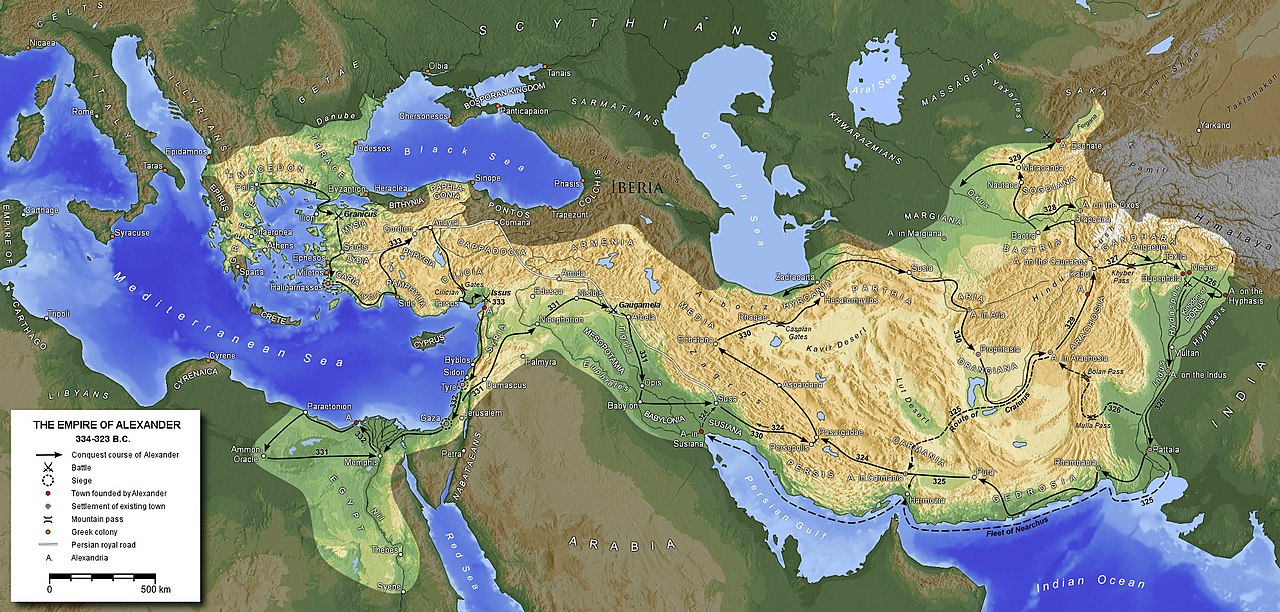
List of cities founded by Alexander the Great

Alexander the Great (356 – 323 BC), a king of ancient Macedon, created one of the largest empires in history by waging an extensive military campaign throughout Asia. Alexander was groomed for rulership from an early age and acceded to the throne after the assassination of his father, Philip II. After subduing rebellious vassals, he invaded the Persian Achaemenid Empire in 334 BC. Alexander swiftly conquered large areas of Western Asia and Egypt before defeating the Persian king Darius III in battle at Issus and Gaugamela. Achieving complete domination over the former lands of the Achaemenids by 327 BC, Alexander attempted to conquer India but turned back after his weary troops mutinied. Following his death aged thirty-two in Babylon in 323 BC, his empire disintegrated in a series of civil wars fought between his followers. Alexander founded numerous settlements during his campaigns, naming them after himself or close followers. These have been the subject of intense debate, as the accounts of ancient and medieval scholars differ wildly and are often contradictory. Plutarch provides the maximum estimate of seventy cities in his Life of Alexander, but most texts attest to between ten and twenty foundations. The Greek Alexander Romance lists between nine and thirteen cities, depending on the recension; the Syriac, Armenian, Hebrew, and Ethiopic versions of the Romance also record twelve or thirteen foundations. Persian sources such as al-Tabari, al-Dinawari, Hamza al-Isfahani, and Qudama ascribe between nine and twelve settlements to Alexander. Stephanus of Byzantium recorded around twenty settlements. Some authors additionally document the number of cities established in a specific area: for example, Strabo records that Alexander founded eight cities in Bactria. The accounts of Alexander's campaigns, primarily those of Arrian, Plutarch, Diodorus, Curtius Rufus, and Justin, provide supplementary evidence. Finally, the geographers Eratosthenes, Ptolemy, and Pliny draw upon the otherwise-lost evidence of Alexander's bematist distance-measurers. When attempting to decipher the above sources, modern scholars face numerous problems. Classical writers tended to name every settlement a polis (πόλις, 'city'), from large population centres to small military garrisons; this leads to much confusion, especially considering the possibility that a settlement started out as a military colony and only later grew into a true polis. Although it is often said that Alexander named all his foundations after himself, this is incorrect; nonetheless, the abundance of these settlements led to many taking on epithets such as Eschate or Oxeiana. As some settlements may have taken on multiple such sobriquets, it is likely that "different authors, undoubtedly reflecting different local traditions, might have been referring to the same Alexandreia by different epithets", in the words of the historian Getzel Cohen. In addition, the precise locations of many foundations are unknown. The classicist William Woodthorpe Tarn noted on the matter that "the difficulties of the subject are considerable, the margin of uncertainty often substantial, the sources of confusion numerous".

Tables

mw- Settlements · Foundations
Alexandria Troas
Alexandria Troas
Settlement nameAlternative name(s)
Alexandria Troas
Year founded
334 BC
Location
The Troad, modern Çanakkale, Turkey
Description
Alexandria Troas is most commonly identified as a 311 BC foundation of Antigonus I, which was refounded a decade later by Lysimachus, another of the Diadochi. The historian W. W. Tarn however theorized that it was a foundation of Alexander; identifying it as Alexander of the Granicus, Tarn asserted that Alexander promised to build a city as a remembrance of his recent victory on the Granicus. This identification is rejected by historians such as Cohen and Fraser.
Historical authenticity
Disputed
Samareia
Samareia
Settlement nameAlternative name(s)
Samareia
Year founded
332–331 BC
Location
Modern Sebastia, State of Palestine
Description
Curtius Rufus recorded that the inhabitants of Samareia rebelled while Alexander was in Egypt; on his return, he punished the rebels and settled Macedonians in the area. It is probable that Perdiccas was ordered to settle the city; alternatively, Victor Tcherikover speculated that he might have refounded the city after Alexander's death in 323 BC. Josephus noted that the inhabitants regained their ruler's favour and were granted permission to rebuild their temple and defences.
Historical authenticity
Disputed
Alexandria near Egypt
Settlement nameAlternative name(s)
Alexandria near Egypt
Year founded
331 BC
Location
Alexandria, Egypt
Description
The first major foundation of Alexander's reign, Alexandria was established on the western Nile Delta between Lake Mareotis and the Mediterranean Sea in early 331 BC. Whether the city was founded before or after Alexander's visit to the Siwa Oasis is disputed; his motives for founding Alexandria are also controversial, with military, political, economic and trading factors often cited. The settlement would later grow into one of the most important cities in the world, with an estimated population of 500,000–600,000 in 1 AD.
Historical authenticity
Accepted
GerasaAntioch on the Chrysorhoas
Settlement nameAlternative name(s)
GerasaAntioch on the Chrysorhoas
Year founded
331 BC
Location
Jerash, Jordan
Description
A late tradition mentioned by Iamblichus connecting the name "Gerasa" to Alexander is probably fanciful. Roman coins found at the site, minted under Septimius Severus, Caracalla, and Elagabalus, are engraved with imagery and inscriptions relating to Alexander, while a pedestal, dated to the early third century BC, mentions the Diadochus Perdiccas. It is thus considered possible that Perdiccas established the settlement on Alexander's orders. However, the epigraphic, numismatic, and literary evidence is late, and it is very possible that the connection to Alexander was a later fabrication.
Historical authenticity
Disputed
Alexandria Ariana
Alexandria Ariana
Settlement nameAlternative name(s)
Alexandria Ariana
Year founded
330 BC
Location
Near modern Herat, Afghanistan
Description
The existence of Alexandria Ariana is attested to by geographers such as Eratosthenes and Pliny and the Islamic chroniclers al-Tabari and Yaqut al-Hamawi, but not by Greek historians such as Arrian or Diodorus Siculus. It is generally accepted that the city was located close to present-day Herat, which is situated in a fertile oasis and on several trade routes; its precise location is unknown because Herat has not been excavated. Alexandria Ariana has sometimes been identified as a refoundation of the Achaemenid settlement Artacoana, but as the available sources outline a clear distinction between the two localities, this is considered unlikely.
Historical authenticity
Accepted
Alexandria Arachosia
Settlement nameAlternative name(s)
Alexandria Arachosia
Year founded
330 BC
Location
Kandahar, Afghanistan
Description
Various sources attest to the existence of a city called Alexandria in Arachosia, Arachotoi, or Arachosiorum oppidum; however, the biographers Arrian and Justin do not mention such a city. Both Fraser and Cohen emphasise that identifying the above names as the same city is an assumption, albeit strong. If true, Alexandria in Arachosia is traditionally identified with Old Kandahar. There is epigraphic evidence to support this theory, with Greek inscriptions such as the Chehel Zina Edict and the Sophytos dedication found in the area. In addition, the early Islamic polymath al-Khwarizmi identified Kandahar as an "Alexandria of the east".
Historical authenticity
Accepted
Alexandria Eschate
Alexandria Eschate
Settlement nameAlternative name(s)
Alexandria Eschate
Year founded
329 BC
Location
Likely near Khujand, Tajikistan
Description
Arrian records that shortly after besieging Cyropolis, Alexander founded a settlement on the lower Jaxartes to defend the area against Scythian tribesmen. The construction of the city took three weeks, and it was settled with Greek mercenaries, local tribesmen, and injured Macedonian veterans. It has traditionally been identified with Khujand, which controlled the Bukhara-Samarkand trade route and the entrance to the fertile Ferghana Valley. Excavations of the modern city have suggested that the Achaemenids had occupied the site. As the refoundation of Cyropolis, a settlement founded by Cyrus the Great, Alexandria Eschate was culturally and militarily important; Fraser terms it "the most politically significant [foundation] since Alexandria in Egypt".
Historical authenticity
Accepted
Alexandria in the CaucasusAlexandria in Parapamisdai
Settlement nameAlternative name(s)
Alexandria in the CaucasusAlexandria in Parapamisdai
Year founded
329 BC
Location
Near the Hindu Kush
Description
All the major historians and Pliny attest to the existence of this settlement, but none use its primary modern toponym. Alexander settled 7,000 natives here alongside 3,000 retired soldiers after journeying from Prophthasia. Returning the following spring, he dismissed the hyparch he had placed in charge and appointed the Companion Nikanor instead. The existence of Alexandria in the Caucasus is generally accepted, but its location is unknown; most theories place it south of the Hindu Kush near modern Begram.
Historical authenticity
Accepted
Alexandria in Margiana
Settlement nameAlternative name(s)
Alexandria in Margiana
Year founded
328 BC
Location
Gyaur-Kala, Turkmenistan
Description
Pliny was the first to attest to the existence of this settlement; he was followed by Strabo, who added that Antiochus I rebuilt the fortifications and founded a city he called Antioch. This latter name is mentioned in the accounts of Ptolemy and Isidore of Charax. Antiochus' walls have been identified at Gyaur-Kala near Merv, which appears as a foundation of Alexander in Muslim sources such as al-Tabari, al-Dinawari, Hamza al-Isfahani, and Qudama. However, there is considerable debate on whether Alexander founded the settlement, or the later Seleucids.
Historical authenticity
Disputed
Boukephala and Nikaia
Settlement nameAlternative name(s)
Boukephala and Nikaia
Year founded
326 BC
Location
On opposite sides of the Hydaspes river, Pakistan
Description
According to Arrian, shortly after defeating the Indian king Porus in battle on the Hydaspes River, Alexander founded two cities facing each other across the river. The battle had taken place on the eastern bank, so Alexander named the eastern city Nikaia; he gave the western city the name Bucephala, after his favourite stallion who had recently died. The location of the cities is unknown: some place them at present-day Jhelum, while others place them thirty miles south at Jalalpur. Considering the marshy nature of the ground and the frequent monsoons, it is unlikely much archaeological evidence could be found. Bucephela survived until the first century AD; much less is known about Nikaia.
Historical authenticity
Accepted
Alexandria in OrietaiAlexandria Rhambakia
Settlement nameAlternative name(s)
Alexandria in OrietaiAlexandria Rhambakia
Year founded
325 BC
Location
Near the mouth of the Indus River in Balochistan, Pakistan
Description
Alexander invaded the territory of the Oritae tribe on his march back from India, taking their headquarters at Rhambakia. Arrian records that he approved of the location and ordered Hephaistion and Leonnatus to construct and settle the city, respectively. Diodorus notes that he named it Alexandria, while Curtius Rufus states that its settlers came from Arachosia. Its purpose was likely to control trade routes, with a harbour for naval trade and access to the strategically important mountain passes of the region. Its location is in doubt, as the coastline has changed significantly since antiquity; one hypothesis places it near present-day Welpat, while another locates the settlement on the Miani Hor lagoon.
Historical authenticity
Uncertain
Charax SpasinuAlexandria in Susiana
Settlement nameAlternative name(s)
Charax SpasinuAlexandria in Susiana
Year founded
324 BC
Location
Likely Naysan, Iraq
Description
Sometimes given the toponym Alexandria in Susiana by modern historians, Charax Spasinu was the later name of a settlement founded by Alexander on the confluence of the Tigris and the Euphrates. The foundation of the settlement was attested to by both Arrian and Pliny the Elder. Likely established to serve as an entrepôt for Babylon, it was later refounded as Antioch by an unknown Seleucid king (probably Antiochus IV Epiphanes) after being damaged by floods. It was again refounded c. 141 BC by the Iranian prince Hyspaosines, who renamed it Spasinou Charax after himself. Although probably located at Naysan in modern Iraq, the city's location has been disputed as the region's hydrography has near-continuously changed since antiquity.
Historical authenticity
Accepted
Settlement nameAlternative name(s)
Year founded
Location
Description
Historical authenticity
Alexandria Troas
334 BC
The Troad, modern Çanakkale, Turkey
Alexandria Troas is most commonly identified as a 311 BC foundation of Antigonus I, which was refounded a decade later by Lysimachus, another of the Diadochi. The historian W. W. Tarn however theorized that it was a foundation of Alexander; identifying it as Alexander of the Granicus, Tarn asserted that Alexander promised to build a city as a remembrance of his recent victory on the Granicus. This identification is rejected by historians such as Cohen and Fraser.
Disputed
Samareia
332–331 BC
Modern Sebastia, State of Palestine
Curtius Rufus recorded that the inhabitants of Samareia rebelled while Alexander was in Egypt; on his return, he punished the rebels and settled Macedonians in the area. It is probable that Perdiccas was ordered to settle the city; alternatively, Victor Tcherikover speculated that he might have refounded the city after Alexander's death in 323 BC. Josephus noted that the inhabitants regained their ruler's favour and were granted permission to rebuild their temple and defences.
Disputed
Alexandria near Egypt
331 BC
Alexandria, Egypt
The first major foundation of Alexander's reign, Alexandria was established on the western Nile Delta between Lake Mareotis and the Mediterranean Sea in early 331 BC. Whether the city was founded before or after Alexander's visit to the Siwa Oasis is disputed; his motives for founding Alexandria are also controversial, with military, political, economic and trading factors often cited. The settlement would later grow into one of the most important cities in the world, with an estimated population of 500,000–600,000 in 1 AD.
Accepted
GerasaAntioch on the Chrysorhoas
331 BC
Jerash, Jordan
A late tradition mentioned by Iamblichus connecting the name "Gerasa" to Alexander is probably fanciful. Roman coins found at the site, minted under Septimius Severus, Caracalla, and Elagabalus, are engraved with imagery and inscriptions relating to Alexander, while a pedestal, dated to the early third century BC, mentions the Diadochus Perdiccas. It is thus considered possible that Perdiccas established the settlement on Alexander's orders. However, the epigraphic, numismatic, and literary evidence is late, and it is very possible that the connection to Alexander was a later fabrication.
Disputed
Alexandria Ariana
330 BC
Near modern Herat, Afghanistan
The existence of Alexandria Ariana is attested to by geographers such as Eratosthenes and Pliny and the Islamic chroniclers al-Tabari and Yaqut al-Hamawi, but not by Greek historians such as Arrian or Diodorus Siculus. It is generally accepted that the city was located close to present-day Herat, which is situated in a fertile oasis and on several trade routes; its precise location is unknown because Herat has not been excavated. Alexandria Ariana has sometimes been identified as a refoundation of the Achaemenid settlement Artacoana, but as the available sources outline a clear distinction between the two localities, this is considered unlikely.
Accepted
Alexandria Arachosia
330 BC
Kandahar, Afghanistan
Various sources attest to the existence of a city called Alexandria in Arachosia, Arachotoi, or Arachosiorum oppidum; however, the biographers Arrian and Justin do not mention such a city. Both Fraser and Cohen emphasise that identifying the above names as the same city is an assumption, albeit strong. If true, Alexandria in Arachosia is traditionally identified with Old Kandahar. There is epigraphic evidence to support this theory, with Greek inscriptions such as the Chehel Zina Edict and the Sophytos dedication found in the area. In addition, the early Islamic polymath al-Khwarizmi identified Kandahar as an "Alexandria of the east".
Accepted
Alexandria Eschate
329 BC
Likely near Khujand, Tajikistan
Arrian records that shortly after besieging Cyropolis, Alexander founded a settlement on the lower Jaxartes to defend the area against Scythian tribesmen. The construction of the city took three weeks, and it was settled with Greek mercenaries, local tribesmen, and injured Macedonian veterans. It has traditionally been identified with Khujand, which controlled the Bukhara-Samarkand trade route and the entrance to the fertile Ferghana Valley. Excavations of the modern city have suggested that the Achaemenids had occupied the site. As the refoundation of Cyropolis, a settlement founded by Cyrus the Great, Alexandria Eschate was culturally and militarily important; Fraser terms it "the most politically significant [foundation] since Alexandria in Egypt".
Accepted
Alexandria in the CaucasusAlexandria in Parapamisdai
329 BC
Near the Hindu Kush
All the major historians and Pliny attest to the existence of this settlement, but none use its primary modern toponym. Alexander settled 7,000 natives here alongside 3,000 retired soldiers after journeying from Prophthasia. Returning the following spring, he dismissed the hyparch he had placed in charge and appointed the Companion Nikanor instead. The existence of Alexandria in the Caucasus is generally accepted, but its location is unknown; most theories place it south of the Hindu Kush near modern Begram.
Accepted
Alexandria in Margiana
328 BC
Gyaur-Kala, Turkmenistan
Pliny was the first to attest to the existence of this settlement; he was followed by Strabo, who added that Antiochus I rebuilt the fortifications and founded a city he called Antioch. This latter name is mentioned in the accounts of Ptolemy and Isidore of Charax. Antiochus' walls have been identified at Gyaur-Kala near Merv, which appears as a foundation of Alexander in Muslim sources such as al-Tabari, al-Dinawari, Hamza al-Isfahani, and Qudama. However, there is considerable debate on whether Alexander founded the settlement, or the later Seleucids.
Disputed
Boukephala and Nikaia
326 BC
On opposite sides of the Hydaspes river, Pakistan
According to Arrian, shortly after defeating the Indian king Porus in battle on the Hydaspes River, Alexander founded two cities facing each other across the river. The battle had taken place on the eastern bank, so Alexander named the eastern city Nikaia; he gave the western city the name Bucephala, after his favourite stallion who had recently died. The location of the cities is unknown: some place them at present-day Jhelum, while others place them thirty miles south at Jalalpur. Considering the marshy nature of the ground and the frequent monsoons, it is unlikely much archaeological evidence could be found. Bucephela survived until the first century AD; much less is known about Nikaia.
Accepted
Alexandria in OrietaiAlexandria Rhambakia
325 BC
Near the mouth of the Indus River in Balochistan, Pakistan
Alexander invaded the territory of the Oritae tribe on his march back from India, taking their headquarters at Rhambakia. Arrian records that he approved of the location and ordered Hephaistion and Leonnatus to construct and settle the city, respectively. Diodorus notes that he named it Alexandria, while Curtius Rufus states that its settlers came from Arachosia. Its purpose was likely to control trade routes, with a harbour for naval trade and access to the strategically important mountain passes of the region. Its location is in doubt, as the coastline has changed significantly since antiquity; one hypothesis places it near present-day Welpat, while another locates the settlement on the Miani Hor lagoon.
Uncertain
Charax SpasinuAlexandria in Susiana
324 BC
Likely Naysan, Iraq
Sometimes given the toponym Alexandria in Susiana by modern historians, Charax Spasinu was the later name of a settlement founded by Alexander on the confluence of the Tigris and the Euphrates. The foundation of the settlement was attested to by both Arrian and Pliny the Elder. Likely established to serve as an entrepôt for Babylon, it was later refounded as Antioch by an unknown Seleucid king (probably Antiochus IV Epiphanes) after being damaged by floods. It was again refounded c. 141 BC by the Iranian prince Hyspaosines, who renamed it Spasinou Charax after himself. Although probably located at Naysan in modern Iraq, the city's location has been disputed as the region's hydrography has near-continuously changed since antiquity.
Accepted
Alexandria near Babylon
Unknown
Unknown
Serious problems surround the identification of this settlement, whose existence was claimed by versions of the Alexander Romance, Yaqut al-Hamawi, and the Cyranides, who located it near Babylon in Lower Mesopotamia. If it existed, it may have been founded by the Seleucid dynasty, although there is no evidence that they named cities after Alexander. Various scholars identify it as identical with other attested Alexandrias, such as Charax Spasinu, Seleucia-on-the-Hedyphon, Alexandria near the Pallakopas, and Alexandria on the Tigris.
Uncertain

References

  1. Sources for Alexander's life and campaigns include Bosworth 1988, Lane Fox 2004, and Briant 2010.
  2. Sources for Alexander's foundations include Tarn 1948, Fraser 1996, and Cohen 2013, pp. 35–37.
  3. Tarn 1948, p. 233.
  4. Hammond 1998, pp. 262–263.
  5. Cohen 2013, pp. 38.
  6. Tarn 1948, p. 232.
  7. Tarn 1948, p. 240; Cohen 1995, p. 148; Fraser 1996, p. 24.
  8. Cohen 2006, pp. 274–277.
  9. Fraser 1996, p. 65; Cohen 2006, pp. 355–362.
  10. Cohen 2006, pp. 248, 404; Fraser 1996, p. 118, note 26.
  11. Fraser 1996, pp. 109–115; Cohen 2013, p. 260.
  12. Fraser 1996, pp. 132–140; Cohen 2013, pp. 255–260.
  13. Fraser 1996, pp. 151–153; Cohen 2013, pp. 252–255.
  14. Fraser 1996, pp. 148–150; Cohen 2013, pp. 263–269.
  15. Fraser 1996, pp. 116–118; Cohen 2013, pp. 245–250.
  16. Fraser 1996, pp. 69–70, 161–162; Cohen 2013, pp. 308–312, 317–318.
  17. Fraser 1996, pp. 71–72, 164–167; Cohen 2013, pp. 297–301.
  18. Fraser 1996, pp. 168–169; Cohen 2013, pp. 109–117, 182.
  19. Fraser 1996, p. 32; Cohen 2013, pp. 117–124.
  20. Cohen 1995, p. 82; Fraser 1996, pp. 29–30.
  21. Cohen 1995, pp. 152, 421–422; Rose 2013, p. 241.
  22. Cohen 1995, pp. 187–188, 422.
  23. Cohen 1995, pp. 422–423.
  24. Cohen 1995, pp. 420–423.
  25. Cohen 2006, pp. 80, 403–404.
  26. Fraser 1996, pp. 20–21; Cohen 2006, p. 403.
  27. Cohen 2006, pp. 404, 406.
  28. Cohen 2006, pp. 403–406.
  29. Tarn 1948, p. 248; Cohen 2013, pp. 85–87.
  30. Cohen 2013, p. 93.
  31. Cohen 2013, pp. 117–124, 192–193.
  32. Cohen 2013, pp. 181–185.
  33. Fraser 1996, p. 29.
  34. Cohen 2013, pp. 244–245; Fraser 1996, pp. 138–140.
  35. Cohen 2013, p. 262.
  36. Cohen 2013, pp. 262–263, 269–271.
  37. Cohen 2013, pp. 320–321, 325–328.
  38. Tarn 1948, p. 244.
Image
Source:
Tip: Wheel or +/− to zoom, drag to pan, Esc to close.