Topzle Topzle

List of ISRO missions

Updated: Wikipedia source

List of ISRO missions

This is a list of ISRO missions. ISRO has carried out 131 spacecraft missions, 101 launch missions and planned several missions including the Gaganyaan (crewed/robotic) and Interplanetary mission such as Lunar Polar Exploration Mission, Chandrayaan-4, Shukrayaan and Mars Lander Mission.

Tables

· Completed missions › Human Spaceflight
Axiom Mission 4
Axiom Mission 4
Mission Name
Axiom Mission 4
Start date
25 June 2025
End date
15 July 2025
Details
Ax‑4 represents a milestone for India's Indian Human Spaceflight Programme, integrating with ISRO's Gaganyaan initiative. While Gaganyaan remains India's independent crewed program, Ax‑4 provided the first opportunity for an Indian astronaut—Shubhanshu Shukla—to fly on a commercial mission to the ISS. In his 18-day stay aboard the ISS, Shukla conducted various experiments developed by ISRO and Indian institutions, including studies of cognitive effects of screen use, microbial adaptation, muscle atrophy, and crop resilience in microgravity.
Mission Name
Start date
End date
Details
Axiom Mission 4
25 June 2025
15 July 2025
Ax‑4 represents a milestone for India's Indian Human Spaceflight Programme, integrating with ISRO's Gaganyaan initiative. While Gaganyaan remains India's independent crewed program, Ax‑4 provided the first opportunity for an Indian astronaut—Shubhanshu Shukla—to fly on a commercial mission to the ISS. In his 18-day stay aboard the ISS, Shukla conducted various experiments developed by ISRO and Indian institutions, including studies of cognitive effects of screen use, microbial adaptation, muscle atrophy, and crop resilience in microgravity.
· Completed missions › Earth
NISAR
NISAR
Mission Name
NISAR
Start date
30 July 2025
End date
TBA
Details
NASA-ISRO Synthetic Aperture Radar (NISAR) is a joint project between NASA and ISRO to co-develop and launch a dual-frequency synthetic aperture radar satellite that is used for remote sensing. It is notable for being the first dual-band radar imaging satellite.
Mission Name
Start date
End date
Details
NISAR
30 July 2025
TBA
NASA-ISRO Synthetic Aperture Radar (NISAR) is a joint project between NASA and ISRO to co-develop and launch a dual-frequency synthetic aperture radar satellite that is used for remote sensing. It is notable for being the first dual-band radar imaging satellite.
· Completed missions › Lunar
Chandrayaan programme
Mission Name
Chandrayaan programme
Mission Name
Chandrayaan-1
Start date
22 October 2008
End date
28 August 2009
Details
Chandrayaan 1 as India's first lunar probe. It was launched by the Indian Space Research Organisation on 22 October 2008, and was operated until August 2009. The mission included a lunar orbiter and an impactor. The mission was a major boost to India's space program, as India researched and developed its own technology in order to explore the Moon. The vehicle was successfully inserted into lunar orbit on 8 November 2008.
Chandrayaan-2
Chandrayaan-2
Mission Name
Chandrayaan-2
Mission Name
22 July 2019
Start date
Orbiter functional; the lander crashed onto Moon's surface due to loss of control (caused by a software glitch) during the final phase of descent.
End date
Chandrayaan-2 was launched from the second launch pad at Satish Dhawan Space Centre on 22 July 2019 at 2:43 PM IST (09:13 UTC) to the Moon by a LVM3 (previously known as GSLV Mk III). The planned or by bit has a perigee of 169.7 km and an apogee of 45475 km. It consists of a lunar orbiter, lander and rover, all developed in India. The main scientific objective is to map the location and abundance of lunar water.
Chandrayaan-3
Chandrayaan-3
Mission Name
Chandrayaan-3
Mission Name
14 July 2023
Start date
10 November 2023 (Orbiter exited lunar sphere of influence)
End date
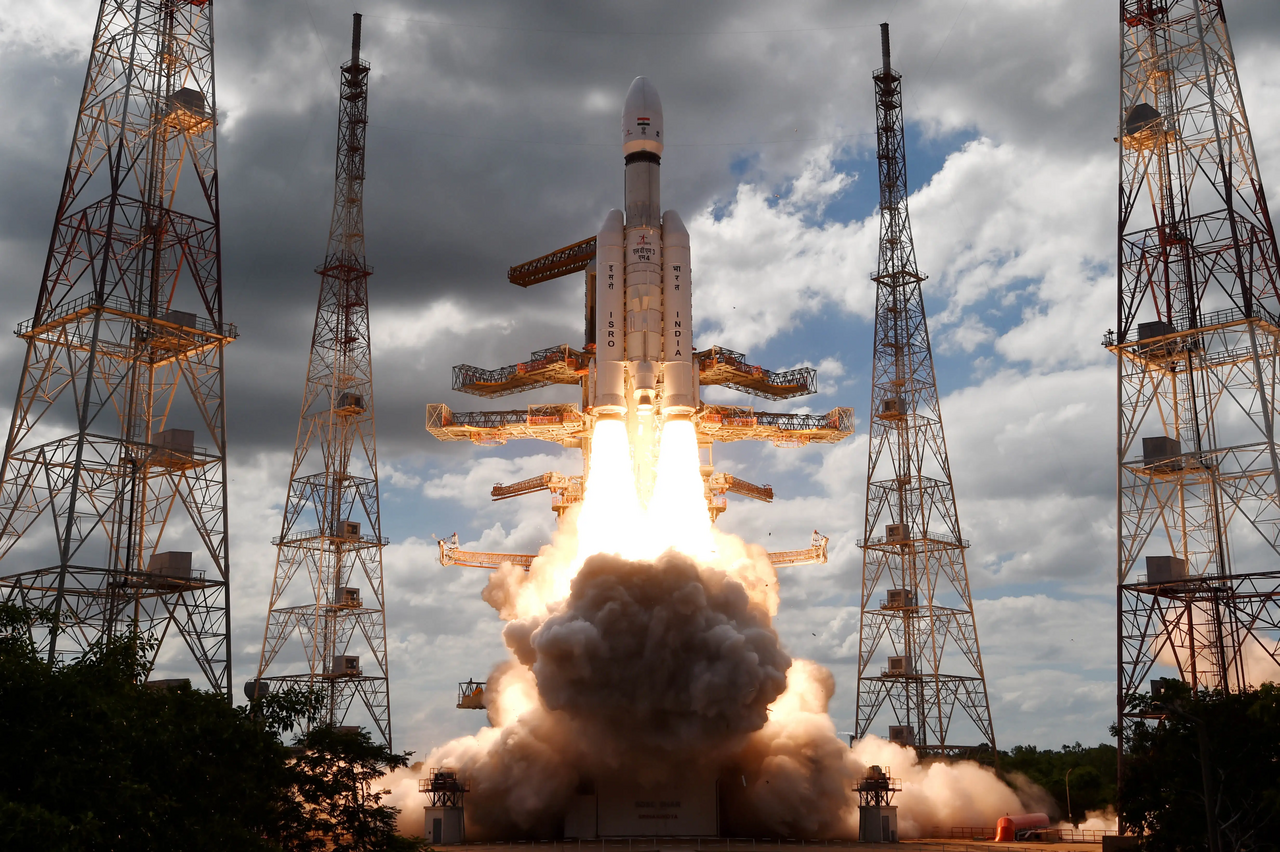
Chandrayaan-3 was launched from the Satish Dhawan Space Centre, Sriharikota on 14 July 2023 at 14:35 IST (UTC +5:30) by LVM3 M4. The main scientific objective is to demonstrate end-to-end capability in safe landing and roving on the lunar surface. The Chandrayaan-3 successfully landed on moon on 23 August 2023 at 18:05 IST (UTC +5:30). For technology demonstration experiments, hop experiment on the Vikram Lander was conducted and the Propulsion Module (PM) of Chandrayaan-3 was moved from an orbit around Moon to an orbit around Earth, where it operated until 22 August 2024.
Mission Name
Start date
End date
Details
Chandrayaan programme
Chandrayaan-1
22 October 2008
28 August 2009
Chandrayaan 1 as India's first lunar probe. It was launched by the Indian Space Research Organisation on 22 October 2008, and was operated until August 2009. The mission included a lunar orbiter and an impactor. The mission was a major boost to India's space program, as India researched and developed its own technology in order to explore the Moon. The vehicle was successfully inserted into lunar orbit on 8 November 2008.
Chandrayaan-2
22 July 2019
Orbiter functional; the lander crashed onto Moon's surface due to loss of control (caused by a software glitch) during the final phase of descent.
Chandrayaan-2 was launched from the second launch pad at Satish Dhawan Space Centre on 22 July 2019 at 2:43 PM IST (09:13 UTC) to the Moon by a LVM3 (previously known as GSLV Mk III). The planned or by bit has a perigee of 169.7 km and an apogee of 45475 km. It consists of a lunar orbiter, lander and rover, all developed in India. The main scientific objective is to map the location and abundance of lunar water.
Chandrayaan-3
14 July 2023
10 November 2023 (Orbiter exited lunar sphere of influence)
Chandrayaan-3 was launched from the Satish Dhawan Space Centre, Sriharikota on 14 July 2023 at 14:35 IST (UTC +5:30) by LVM3 M4. The main scientific objective is to demonstrate end-to-end capability in safe landing and roving on the lunar surface. The Chandrayaan-3 successfully landed on moon on 23 August 2023 at 18:05 IST (UTC +5:30). For technology demonstration experiments, hop experiment on the Vikram Lander was conducted and the Propulsion Module (PM) of Chandrayaan-3 was moved from an orbit around Moon to an orbit around Earth, where it operated until 22 August 2024.
· Completed missions › Solar
Aditya-L1
Aditya-L1
Mission Name
Aditya-L1
Start date
2 September 2023
End date
TBD
Details
Aditya-L1 is the first Indian observatory class mission to study the solar corona using a solar coronagraph and also chromosphere using near UV instrument. X-ray spectroscopic instruments will provide flare spectra while the in-situ payload observes the solar events during their passage from Sun to Earth. On 6 January 2024, Aditya-L1 spacecraft, India's first solar mission, has successfully entered its final orbit around the first Sun-Earth Lagrangian point (L1), approximately 1.5 million kilometers from Earth.
Mission Name
Start date
End date
Details
Aditya-L1
2 September 2023
TBD
Aditya-L1 is the first Indian observatory class mission to study the solar corona using a solar coronagraph and also chromosphere using near UV instrument. X-ray spectroscopic instruments will provide flare spectra while the in-situ payload observes the solar events during their passage from Sun to Earth. On 6 January 2024, Aditya-L1 spacecraft, India's first solar mission, has successfully entered its final orbit around the first Sun-Earth Lagrangian point (L1), approximately 1.5 million kilometers from Earth.
· Completed missions › Interplanetary
Mars Orbiter Mission
Mission Name
Mars Orbiter Mission
Start date
5 November 2013
End date
2 October 2022
Details
Mars Orbiter Mission (MOM), also called Mangalyaan, is a spacecraft orbiting Mars since 24 September 2014. It was launched on 5 November 2013 by the Indian Space Research Organization (ISRO). It is India's first interplanetary spaceflight mission and ISRO has become the fourth space agency to reach Mars, after the Soviet space program, NASA, and the European Space Agency. India is the first Asian nation to reach Mars orbit, and the first nation in the world to do so in its first attempt.
Mission Name
Start date
End date
Details
Mars Orbiter Mission
5 November 2013
2 October 2022
Mars Orbiter Mission (MOM), also called Mangalyaan, is a spacecraft orbiting Mars since 24 September 2014. It was launched on 5 November 2013 by the Indian Space Research Organization (ISRO). It is India's first interplanetary spaceflight mission and ISRO has become the fourth space agency to reach Mars, after the Soviet space program, NASA, and the European Space Agency. India is the first Asian nation to reach Mars orbit, and the first nation in the world to do so in its first attempt.
· Completed missions › Astronomy
ASTROSAT
ASTROSAT
Mission Name
ASTROSAT
Start date
28 September 2015
End date
Ongoing
Details
ASTROSAT is an Indian Astronomy satellite mission launched by ISRO on 28 September 2015, which enabled multi-wavelength observations of the celestial bodies and cosmic sources in X-ray and UV spectral bands simultaneously. The scientific payloads cover the Visible (3500–6000 Å...), UV (1300–op Å...), soft and hard X-ray regimes (0.5–8 keV; 3–80 keV). The uniqueness of ASTROSAT lies in its wide spectral coverage extending over visible, UV, soft and hard X-ray regions.
X-ray Polarimeter Satellite
Mission Name
X-ray Polarimeter Satellite
Start date
1 January 2024
End date
TBD
Details
The X-ray Polarimeter Satellite (XPoSat) is a ISRO space observatory to study polarization of cosmic X-rays. It was launched on 1 January 2024 on a Polar Satellite Launch Vehicle (PSLV-C58). XPoSat will study the 50 brightest known sources in the universe, including pulsars, black hole X-ray binaries, active galactic nuclei, and non-thermal supernova remnants.
Mission Name
Start date
End date
Details
ASTROSAT
28 September 2015
Ongoing
ASTROSAT is an Indian Astronomy satellite mission launched by ISRO on 28 September 2015, which enabled multi-wavelength observations of the celestial bodies and cosmic sources in X-ray and UV spectral bands simultaneously. The scientific payloads cover the Visible (3500–6000 Å...), UV (1300–op Å...), soft and hard X-ray regimes (0.5–8 keV; 3–80 keV). The uniqueness of ASTROSAT lies in its wide spectral coverage extending over visible, UV, soft and hard X-ray regions.
X-ray Polarimeter Satellite
1 January 2024
TBD
The X-ray Polarimeter Satellite (XPoSat) is a ISRO space observatory to study polarization of cosmic X-rays. It was launched on 1 January 2024 on a Polar Satellite Launch Vehicle (PSLV-C58). XPoSat will study the 50 brightest known sources in the universe, including pulsars, black hole X-ray binaries, active galactic nuclei, and non-thermal supernova remnants.
· Planned mission's of ISRO
Gaganyaan 1
Gaganyaan 1
Mission name
Gaganyaan 1
Expected launch
Q4 2025
Spacecraft
Test flight (uncrewed)
Details
Gaganyaan ("Orbital Vehicle") is an Indian crewed orbital spacecraft (jointly made by ISRO and HAL) intended to be the basis of the Indian Human Spaceflight Programme. The spacecraft is being designed to carry three people, and a planned upgraded version will be equipped with rendezvous and docking capability. This will be the first of three flight tests prior to the inaugural of crewed mission.
Gaganyaan-2
Gaganyaan-2
Mission name
Gaganyaan-2
Expected launch
2026
Spacecraft
Test flight (uncrewed)
Details
Second of the three flight tests prior to the inaugural crewed mission.
Gaganyaan 3
Gaganyaan 3
Mission name
Gaganyaan 3
Expected launch
2026
Spacecraft
Test flight (uncrewed)
Details
Last of the three flight tests prior to the inaugural crewed mission.
Gaganyaan 4
Gaganyaan 4
Mission name
Gaganyaan 4
Expected launch
2026
Spacecraft
Test flight (crewed)
Details
First crewed Gaganyaan mission. If successful, India would become the fourth country in the world (after the US, Soviet Union and China) to independently send humans in space.
Chandrayaan-4
Chandrayaan-4
Mission name
Chandrayaan-4
Expected launch
2027
Spacecraft
Lunar lander, sample return
Details
Chandrayaan-4 is a planned lunar sample-return mission of the Indian Space Research Organisation (ISRO) and will be the fourth iteration in its Chandrayaan programme. It consist of four modules namely Transfer module (TM), Lander module (LM), Ascender module (AM) and Reentry Module (RM).
Venus Orbiter Mission
Mission name
Venus Orbiter Mission
Expected launch
29 March 2028
Spacecraft
Venus orbiter
Details
The Venus Orbiter Mission is a planned orbiter to study the atmosphere of Venus.
Lunar Polar Exploration Mission
Mission name
Lunar Polar Exploration Mission
Expected launch
2028–29
Spacecraft
Lunar lander, rover
Details
Lunar Polar Exploration Mission, known as Chandrayaan-5 in India, is a proposed mission by JAXA and ISRO to explore the south pole region of the Moon. The mission concept has been formally proposed for funding and planning.
Bharatiya Antariksha Station
Mission name
Bharatiya Antariksha Station
Expected launch
2028–2035
Spacecraft
Space station
Details
The Bharatiya Antariksha Station (referred in the media as Indian Space Station) is a planned space station to be constructed by India and operated by the (ISRO). The space station would weigh 20 tonnes and maintain an orbit of approximately 400 kilometres above the Earth, where astronauts could stay for 15–20 days.
AstroSat-2
AstroSat-2
Mission name
AstroSat-2
Expected launch
TBD
Spacecraft
Space telescope
Details
AstroSat-2 is India's second dedicated multi-wavelength space telescope, proposed by the Indian Space Research Organization (ISRO) as the successor of the current Astrosat-1 observatory. ISRO launched an 'Announcement of Opportunity in February 2018 requesting proposals from Indian scientists for ideas and the development of instruments for astronomy and astrophysics.
Mars Lander Mission
Mars Lander Mission
Mission name
Mars Lander Mission
Expected launch
2031
Spacecraft
Mars Lander, Rover, Helicopter
Details
Mars Lander Mission also called as Mangalyaan 2 is India's second interplanetary mission planned for launch to Mars. It will have a lander along with a rover and a helicopter like Ingenuity (NASA) and will demonstrate the capability of landing on Mars.
Mission name
Expected launch
Spacecraft
Details
Gaganyaan 1
Q4 2025
Test flight (uncrewed)
Gaganyaan ("Orbital Vehicle") is an Indian crewed orbital spacecraft (jointly made by ISRO and HAL) intended to be the basis of the Indian Human Spaceflight Programme. The spacecraft is being designed to carry three people, and a planned upgraded version will be equipped with rendezvous and docking capability. This will be the first of three flight tests prior to the inaugural of crewed mission.
Gaganyaan-2
2026
Test flight (uncrewed)
Second of the three flight tests prior to the inaugural crewed mission.
Gaganyaan 3
2026
Test flight (uncrewed)
Last of the three flight tests prior to the inaugural crewed mission.
Gaganyaan 4
2026
Test flight (crewed)
First crewed Gaganyaan mission. If successful, India would become the fourth country in the world (after the US, Soviet Union and China) to independently send humans in space.
Chandrayaan-4
2027
Lunar lander, sample return
Chandrayaan-4 is a planned lunar sample-return mission of the Indian Space Research Organisation (ISRO) and will be the fourth iteration in its Chandrayaan programme. It consist of four modules namely Transfer module (TM), Lander module (LM), Ascender module (AM) and Reentry Module (RM).
Venus Orbiter Mission
29 March 2028
Venus orbiter
The Venus Orbiter Mission is a planned orbiter to study the atmosphere of Venus.
Lunar Polar Exploration Mission
2028–29
Lunar lander, rover
Lunar Polar Exploration Mission, known as Chandrayaan-5 in India, is a proposed mission by JAXA and ISRO to explore the south pole region of the Moon. The mission concept has been formally proposed for funding and planning.
Bharatiya Antariksha Station
2028–2035
Space station
The Bharatiya Antariksha Station (referred in the media as Indian Space Station) is a planned space station to be constructed by India and operated by the (ISRO). The space station would weigh 20 tonnes and maintain an orbit of approximately 400 kilometres above the Earth, where astronauts could stay for 15–20 days.
AstroSat-2
TBD
Space telescope
AstroSat-2 is India's second dedicated multi-wavelength space telescope, proposed by the Indian Space Research Organization (ISRO) as the successor of the current Astrosat-1 observatory. ISRO launched an 'Announcement of Opportunity in February 2018 requesting proposals from Indian scientists for ideas and the development of instruments for astronomy and astrophysics.
Mars Lander Mission
2031
Mars Lander, Rover, Helicopter
Mars Lander Mission also called as Mangalyaan 2 is India's second interplanetary mission planned for launch to Mars. It will have a lander along with a rover and a helicopter like Ingenuity (NASA) and will demonstrate the capability of landing on Mars.

References

  1. "List of missions"
    http://www.isro.gov.in/Mission.html
  2. Hindustan Times
    https://tech.hindustantimes.com/tech/news/isro-upcoming-space-missions-and-launches-2023-see-the-complete-list-here-71671607920701.html
  3. "Ax-4 Research Overview"
    https://www.axiomspace.com/mission-blog/ax4-researchoverview
  4. "Gaganyaan – India's Human Spaceflight Program"
    https://www.isro.gov.in/Gaganyaan.html
  5. NASA
    https://www.nasa.gov/missions/station/iss-research/nasa-isro-research-aboard-fourth-private-astronaut-mission-to-station/
  6. "NISAR"
    https://www.jpl.nasa.gov/missions/nasa-isro-synthetic-aperture-radar-nisar/
  7. "Chandrayaan-1"
    http://www.isro.gov.in/pslv-c11-chandrayaan-i
  8. "Chandrayaan-1"
    https://web.archive.org/web/20071114122718/http://solarsystem.nasa.gov/missions/profile.cfm?MCode=Chandrayaan
  9. The Week
    https://web.archive.org/web/20230824035118/https://www.theweek.in/news/sci-tech/2019/11/16/how-did-chandrayaan-2-fail-isro-answer.html
  10. X (Formerly Twitter)
    https://x.com/coastal8049/status/1826716028837241233
  11. www.isro.gov.in
    https://www.isro.gov.in/Ch3_Propulsion_Module_moved_from_Lunar_orbit_to_Earth_orbit.html
  12. The Indian Express
    https://indianexpress.com/article/india/aries-to-train-next-generation-solar-scientists-ahead-of-indias-aditya-l1-mission-7291677/
  13. www.isro.gov.in
    https://www.isro.gov.in/halo-orbit-insertion-adtya-l1.html
  14. "Mars Orbiter Mission Spacecraft"
    http://www.isro.gov.in/Spacecraft/mars-orbiter-mission-spacecraft
  15. "Mars Orbiter Mission"
    http://www.space.com/topics/india-mars-orbiter-mission/
  16. https://www.isro.gov.in/media_isro/pdf/AnnualReport/Annual_Report_2024_25_Eng.pdf
    https://www.isro.gov.in/media_isro/pdf/AnnualReport/Annual_Report_2024_25_Eng.pdf
  17. "PSLV Successfully Launches India's Multi Wavelength Space Observatory ASTROSAT"
    https://web.archive.org/web/20150930173927/http://www.isro.gov.in/update/28-sep-2015/pslv-successfully-launches-india%E2%80%99s-multi-wavelength-space-observatory-astrosat
  18. The Times of India
    https://timesofindia.indiatimes.com/india/isros-pslv-c58-xposat-mission-successful-satellite-set-to-study-x-ray-emissions-from-black-holes-and-other-celestial-objects/articleshow/106431920.cms?from=mdr
  19. Hindustan Times
    https://www.hindustantimes.com/india-news/isro-launches-xposat-satellite-to-study-black-hole-101704079975577.html
  20. Hindustan Times
    https://www.hindustantimes.com/india-news/pslvc58-xposat-why-did-isro-launch-x-ray-polarimeter-satellite-whats-the-mission-objective-101704090314844.html
  21. www.isro.gov.in
    https://www.isro.gov.in/PSLV_C58_XPoSat_Mission.html
  22. SpaceNews
    https://spacenews.com/india-to-target-moons-south-pole-with-sample-return-mission/
  23. SpaceNews
    https://spacenews.com/india-approves-moon-sample-return-venus-orbiter-space-station-module-and-reusable-launcher/
Image
Source:
Tip: Wheel or +/− to zoom, drag to pan, Esc to close.