
John Brown (abolitionist)
Updated: Wikipedia source
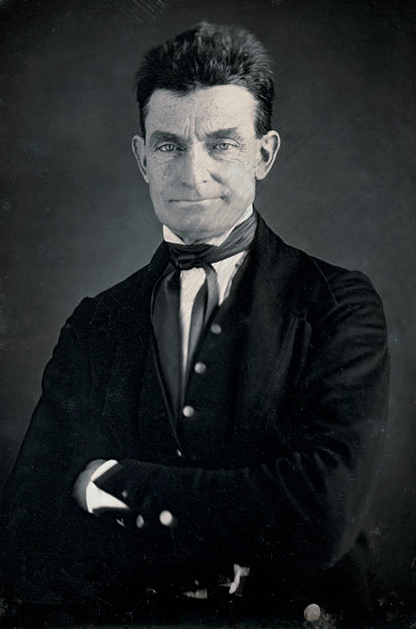
John Brown (May 9, 1800 – December 2, 1859) was an American Christian abolitionist in the decades preceding the American Civil War. First reaching national prominence in the 1850s for his radical abolitionism and fighting in Bleeding Kansas, Brown was captured, tried, and executed by the Commonwealth of Virginia for a raid and incitement of a slave rebellion at Harpers Ferry, Virginia, in 1859. An evangelical Christian of strong religious convictions, Brown was profoundly influenced by the Puritan faith of his upbringing. He believed that he was "an instrument of God", raised to strike the "death blow" to slavery in the United States, a "sacred obligation". Brown was the leading exponent of violence in the American abolitionist movement, believing it was necessary to end slavery after decades of peaceful efforts had failed. Brown said that in working to free the enslaved, he was following Christian ethics, including the Golden Rule, and the Declaration of Independence, which states that "all men are created equal". He stated that in his view, these two principles "meant the same thing". Brown first gained national attention when he led anti-slavery volunteers and his sons during the Bleeding Kansas crisis of the late 1850s, a state-level civil war over whether Kansas would enter the Union as a slave state or a free state. He was dissatisfied with abolitionist pacifism, saying of pacifists, "These men are all talk. What we need is action—action!" In May 1856, Brown and his sons killed five supporters of slavery in the Pottawatomie massacre, a response to the sacking of Lawrence by pro-slavery forces. Brown then commanded anti-slavery forces at the Battle of Black Jack and the Battle of Osawatomie. In October 1859, Brown led a raid on the federal armory at Harpers Ferry, Virginia (which later became part of West Virginia), intending to start a slave liberation movement that would spread south; he had prepared a Provisional Constitution for the revised, slavery-free United States that he hoped to bring about. He seized the armory, but seven people were killed and ten or more were injured. Brown intended to arm slaves with weapons from the armory, but only a few slaves joined his revolt. Those of Brown's men who had not fled were killed or captured by local militia and U . Marines, the latter led by Robert E. Lee. Brown was tried for treason against the Commonwealth of Virginia, the murder of five men, and inciting a slave insurrection. He was found guilty of all charges and was hanged on December 2, 1859, the first person executed for treason in the history of the United States. The Harpers Ferry raid and Brown's trial, both covered extensively in national newspapers, escalated tensions that in the next year led to the South's long-threatened secession from the United States and the American Civil War. Southerners feared that others would soon follow in Brown's footsteps, encouraging and arming slave rebellions. He was widely viewed as a hero and icon in the North. Union soldiers marched to the new song "John Brown's Body" that portrayed him as a heroic martyr. Brown has been variously described as a heroic martyr and visionary, and as a madman and terrorist.