
Topzle Topzle

Harry Crerar

Updated: Wikipedia source
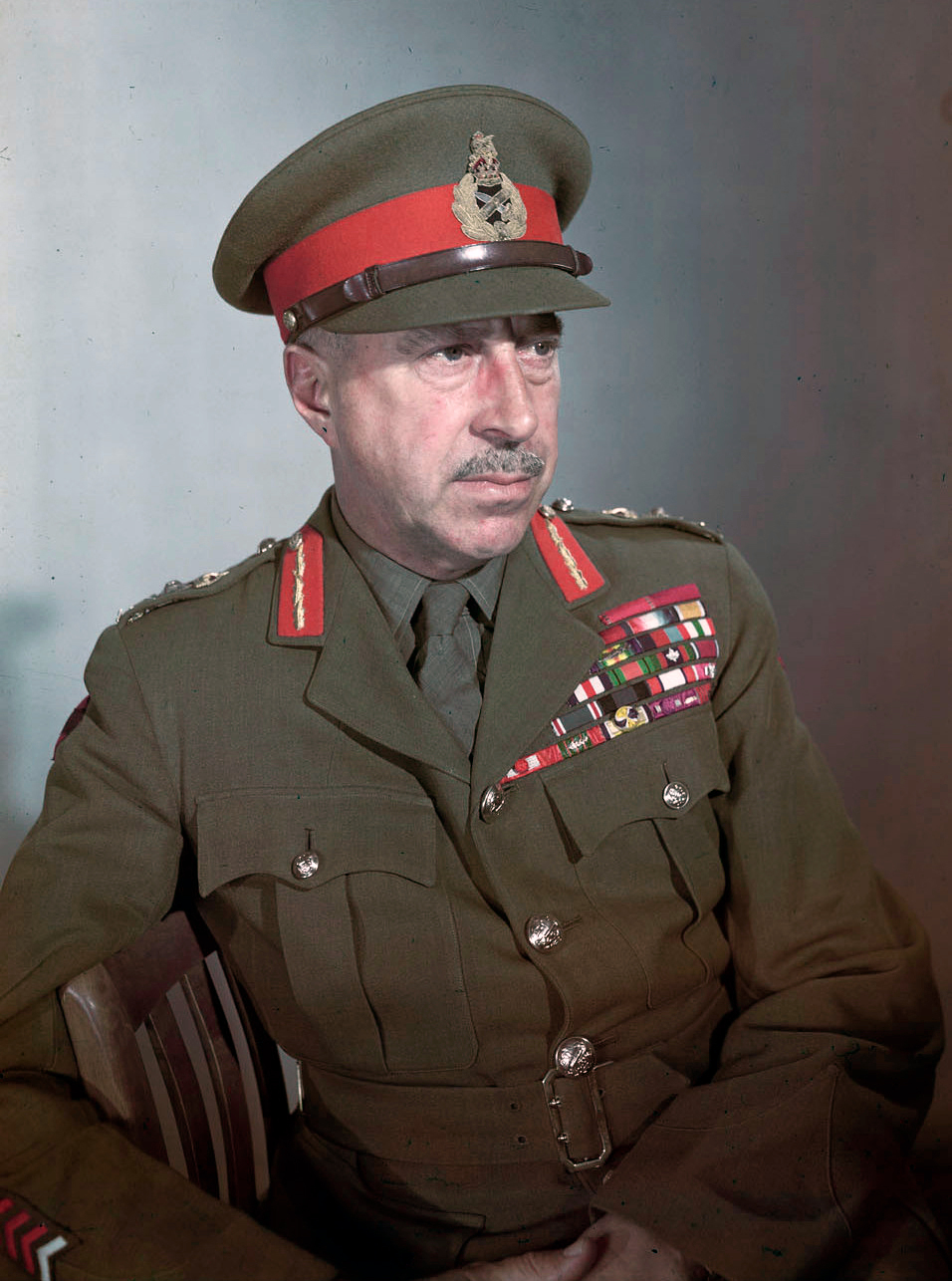
Harry Crerar

Henry Duncan Graham Crerar, (28 April 1888 – 1 April 1965) was a senior officer of the Canadian Army who became the country's senior field commander in the Second World War as commander of the First Canadian Army in the campaign in North West Europe in 1944–1945, having rapidly risen in rank from brigadier in 1939 to full general in 1944. A graduate of the Royal Military College of Canada in Kingston, Ontario, Crerar was commissioned as a lieutenant in the Non-Permanent Active Militia in 1909, serving with the 4th Battery, Canadian Field Artillery, which was based in Hamilton, Ontario. He rose to the rank of lieutenant-colonel in the artillery. He saw action in the First World War, for which he was mentioned in despatches and made a companion of the Distinguished Service Order. Electing to remain in the army as a professional soldier after the war, he attended the Staff College, Camberley, from 1923 to 1924, and the Imperial Defence College in 1934. He was appointed Director of Military Operations & Military Intelligence in 1935 and Commandant of the Royal Military College of Canada in 1939. During the Second World War, Crerar became General Officer Commanding the 2nd Canadian Infantry Division, which was then stationed in England, in late 1941. He shares responsibility for initiating and reviving the tragic Dieppe Raid in 1942. He was promoted to lieutenant-general and assumed command of I Canadian Corps, fighting briefly in the Italian campaign in late 1943 and in early 1944. In March 1944 he returned to the United Kingdom where he assumed command of the First Canadian Army which, despite its designation, contained a significant number of British, Polish and Czech troops, including the British I Corps and the Polish 1st Armoured Division. Under Crerar's command, the First Canadian Army fought in the latter stages of the Battle of Normandy in July−August 1944, participating in Operation Totalize, Operation Tractable and the Battle of the Falaise Pocket, before clearing the Channel Coast. Crerar was promoted to full general on 16 November 1944, becoming the first Canadian officer to hold that rank in the field. During Operation Veritable, the battle for the Rhineland in 1945, the First Canadian Army controlled nine British divisions. The Army became more Canadian with Operation Goldflake, the redeployment of the I Canadian Corps from Italy and played a key role in the liberation of the western Netherlands in April 1945, shortly before the end of World War II in Europe. Crerar retired from military service in 1946. The Canadian military historian, J. L. Granatstein, wrote of Crerar that: "No other single officer had such impact on the raising, fighting, and eventual disbanding of the greatest army Canada has ever known. Crerar was unquestionably the most important Canadian soldier of the war".

Infobox

Born
Henry Duncan Graham Crerar (1888-04-28)28 April 1888 Hamilton, Ontario, Canada
Died
1 April 1965(1965-04-01) (aged 76) Ottawa, Ontario, Canada
Buried
Beechwood Cemetery
Allegiance
Canada
Branch
Canadian Army
Service years
1909–1946
Rank
General
Unit
Royal Canadian Artillery
Commands
Royal Military College of Canada Chief of the General Staff 2nd Canadian Infantry Division I Canadian Corps First Canadian Army
Conflicts
First World War Battle of Neuve Chapelle Second Battle of Ypres Battle of Flers–Courcelette Battle of Vimy Ridge Battle of Amiens Battle of Valenciennes Second World War Italian Campaign Battle of Normandy Clearing the Channel Coast Western Allied invasion of Germany
Awards
Member of the Order of the Companions of Honour Companion of the Order of the Bath Companion of the Distinguished Service Order Knight of the Venerable Order of Saint John Recipient of the Canadian Forces' Decoration Mentioned in despatches (5) Foreign awards Legion of Merit (US) Army Distinguished Service Medal (US) Grand Officer of the Order of Leopold (Belgium) Croix de Guerre 1940 with Palm (Belgium) 5th Class Order of Virtuti Militari (Poland) Order of the White Lion (Czechoslovakia) War Cross 1939–1945 (Czechoslovakia) Commander of the Legion of Honour (France) Croix de Guerre 1939–1945 avec Palme (France) Grand Cross of the Order of Orange Nassau with Swords (Netherlands)
Relations
Adam Beck (brother-in-law)
Other work
Aide-de-Camp General to the King Aide-de-Camp General to the Queen Queen's Privy Council for Canada

Tables

· External links
Preceded byKenneth Stuart
Military offices
Preceded byKenneth Stuart
Military offices
Commandant of the Royal Military College of Canada 1938–1939
Military offices
Succeeded byHarold Matthews
Preceded byThomas Anderson
Military offices
Preceded byThomas Anderson
Military offices
Chief of the General Staff 1940–1941
Military offices
Succeeded byKenneth Stuart
Preceded byVictor Odlum
Military offices
Preceded byVictor Odlum
Military offices
GOC 2nd Canadian Infantry Division 1941–1942
Military offices
Succeeded byJohn Roberts
Preceded byAndrew McNaughton
Military offices
Preceded byAndrew McNaughton
Military offices
GOC I Canadian Corps 1942–1944
Military offices
Succeeded byE. L. M. Burns
Preceded byKenneth Stuart
Military offices
Preceded byKenneth Stuart
Military offices
GOC Canadian First Army 1944–1945
Military offices
Succeeded byPost disbanded
Military offices
Preceded byKenneth Stuart
Commandant of the Royal Military College of Canada 1938–1939
Succeeded byHarold Matthews
Preceded byThomas Anderson
Chief of the General Staff 1940–1941
Succeeded byKenneth Stuart
Preceded byVictor Odlum
GOC 2nd Canadian Infantry Division 1941–1942
Succeeded byJohn Roberts
Preceded byAndrew McNaughton
GOC I Canadian Corps 1942–1944
Succeeded byE. L. M. Burns
Preceded byKenneth Stuart
GOC Canadian First Army 1944–1945
Succeeded byPost disbanded

References

  1. Granatstein 1993, p. 83.
  2. Dictionary of Canadian Biography
    http://www.biographi.ca/en/bio/crerar_henry_duncan_graham_19E.html
  3. Dickson 2007, pp. 7–8.
  4. Dickson 2007, pp. 11–14.
  5. Dickson 2007, pp. 14–17.
  6. Dickson 2007, pp. 19–21.
  7. Dickson 2007, pp. 19–21, 27.
  8. Dickson 2007, pp. 25–29.
  9. Rawling 1992, p. 18.
  10. Dickson 2007, pp. 25–30.
  11. Dickson 2007, pp. 31–33.
  12. Dickson 2007, p. 31.
  13. Rawling 1992, pp. 22–23.
  14. Dickson 2007, pp. 35–39.
  15. Dickson 2007, p. 47.
  16. Dickson 2007, pp. 49–54.
  17. Granatstein 1993, p. 86.
  18. The London Gazette
    https://www.thegazette.co.uk/London/issue/30107/supplement/5425
  19. The London Gazette
    https://www.thegazette.co.uk/London/issue/30111/supplement/5475
  20. Dickson 2007, pp. 55–59.
Image
Source:
Tip: Wheel or +/− to zoom, drag to pan, Esc to close.