
Topzle Topzle

Harold Godwinson

Updated: Wikipedia source
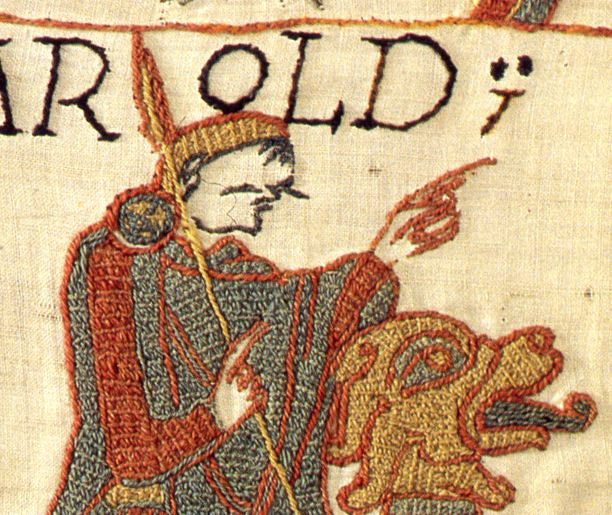
Harold Godwinson

Harold Godwinson (died 14 October 1066), also called Harold II, was the last crowned Anglo-Saxon king of England. Harold reigned from 6 January 1066 until his death at the Battle of Hastings on 14 October 1066, the decisive battle of the Norman Conquest. He was succeeded by William the Conqueror, the victor at Hastings. Harold Godwinson was a member of the most powerful noble family in England, his father Godwin having been made earl of Wessex by King Cnut the Great. Harold, who served previously as earl of East Anglia, was appointed to his father's earldom on Godwin's death. After his brother-in-law, King Edward the Confessor, died childless on 5 January 1066, the Witenagemot convened and chose Harold to succeed him; he was probably the first English monarch to be crowned in Westminster Abbey. In late September, he defeated an invasion by rival claimant Harald Hardrada of Norway in the Battle of Stamford Bridge near York before marching his army back south to meet William at Hastings two weeks later, where he was killed in battle.

Infobox

Reign
5 January – 14 October 1066
Coronation
6 January 1066
Predecessor
Edward the Confessor
Successor
mw- Edgar Ætheling (uncrowned) William I (crowned)
Born
Wessex, England
Died
(1066-10-14)14 October 1066near Senlac Hill, Sussex, England
Burial
Waltham Abbey, Essex, or Bosham, Sussex (disputed)
Spouses
Edith the Fair Edith of Mercia
Issue
Godwin Edmund Magnus Gunhild Gytha Harold Ulf
House
Godwin
Father
Godwin, Earl of Wessex
Mother
Gytha Thorkelsdóttir

Tables

· External links
Regnal titles
Regnal titles
Harold Godwinson House of Godwin Died: 14 October 1066
Regnal titles
Preceded byEdward the Confessor
Harold Godwinson House of Godwin Died: 14 October 1066
Preceded byEdward the Confessor
Harold Godwinson House of Godwin Died: 14 October 1066
King of the English 1066
Harold Godwinson House of Godwin Died: 14 October 1066
Succeeded byWilliam I
Peerage of England
Peerage of England
Harold Godwinson House of Godwin Died: 14 October 1066
Peerage of England
Preceded byÆlfgār
Preceded byÆlfgār
Harold Godwinson House of Godwin Died: 14 October 1066
Preceded byÆlfgār
Harold Godwinson House of Godwin Died: 14 October 1066
Earl of East Anglia 1052–1053
Harold Godwinson House of Godwin Died: 14 October 1066
Succeeded byÆlfgār
Preceded byGodwin
Preceded byGodwin
Harold Godwinson House of Godwin Died: 14 October 1066
Preceded byGodwin
Harold Godwinson House of Godwin Died: 14 October 1066
Earl of Wessex 1st creation1053–1066
Harold Godwinson House of Godwin Died: 14 October 1066
Merged in Crown
Harold Godwinson House of Godwin Died: 14 October 1066
Regnal titles
Preceded byEdward the Confessor
King of the English 1066
Succeeded byWilliam I
Peerage of England
Preceded byÆlfgār
Earl of East Anglia 1052–1053
Succeeded byÆlfgār
Preceded byGodwin
Earl of Wessex 1st creation1053–1066
Merged in Crown

References

  1. Eadsige was Archbishop of Canterbury at the time of Earl Godwine. Eadsige's relations with Christ Church, Canterbury may
  2. A team of a archaeologists from Newcastle University, and the University of Exeter, claim to have uncovered evidence tha
  3. Edward may not have been blameless in this situation, as at least one other man, Sweyn II of Denmark, also thought Edwar
  4. Bayeux Tapestry, in which the place is called in Latin Belrem
  5. Frank Barlow points out that the author of the Vita, who appears to have looked favourably on Harold, was writing after
  6. This was in preference to Edward's great-nephew, Edgar the Ætheling, who had yet to reach maturity.
  7. Who also claimed the English crown through a succession pact concluded between Harthacnut, king of England and Denmark,
  8. also known as Edyth Swannesha (Edith Swanneck)
  9. 5.5 feet (1.7 m)
  10. Harold was thought to have been in his 40s at his death
  11. At midsummer in 1069, Brian of Brittany and Alan the Black led a force that defeated a raid by Godwine and Edmund, sons
  12. The pagan English had been polygynous. When the English were evangelised, although by church law concubinage would not h
  13. DeVries 1999, p. 230.
  14. Walker 2000, p. 10.
  15. Barlow 1988, p. 451.
  16. Walker 2000, pp. 7–9.
  17. Walker 2000, p. 12.
  18. Walker 2000, pp. 13–15.
  19. Walker 2000, p. 16.
  20. Walker 2000, pp. 17–18.
  21. Mason 2004, p. 35
  22. Rex 2005, p. 31
  23. Hunt 2004.
  24. Barlow 2013, p. 32.
  25. Gould 2025, pp. 1–35.
  26. Walker 2000, pp. 18–19.
  27. Barlow 1970, p. 74.
  28. Walker 2000, p. 20.
  29. Walker 2000, pp. 127–128.
  30. Walker 2000, p. 22.
  31. Walker 2000, pp. 24–25.
  32. Fleming 2010.
  33. Chisholm 1911, p. 11.
  34. Encyclopædia Britannica
    https://www.britannica.com/biography/Harold-II
  35. Howarth 1983, pp. 69–70.
  36. Howarth 1983, pp. 71–72.
  37. Freeman 1869, pp. 165–166.
  38. Ordericus Vitalis 1853, pp. 459–460.
  39. Barlow 1970, p. 251.
  40. "Westminster Abbey Official site – Coronations"
    https://web.archive.org/web/20091016073106/http://www.westminster-abbey.org/our-history/royals/coronations
  41. Hagger 2012, pp. 38–39.
  42. Gibson 1978, p. 111.
  43. Morris 2012, pp. 142–143, pp. 150–151.
  44. Hagger 2012, p. 43.
  45. Morris 2012, pp. 154–165.
  46. Freeman 1869, p. 365.
  47. Sturluson 1966, p. 149.
  48. Brown 1980, pp. 7–9.
  49. Grainge & Grainge 1999, pp. 130–142.
  50. Freeman 1999, pp. 150–164.
  51. Foys 2010, pp. 161–163.
  52. Morris 2012, pp. 183–187.
  53. Foys 2016.
  54. Livingston 2022.
  55. Society of Antiquaries of London 2020.
  56. Bernstein 1986, pp. 148–152.
  57. Foys 2010, pp. 171–175.
  58. Brooks & Walker 1997, pp. 63–92.
  59. Hill 2003.
  60. Bosham Online 2003.
  61. Fryde et al. 2003, p. 29.
  62. Walker 2000, pp. 181–182
  63. Bartlett & Jeffery 1997, p. 59.
  64. Barlow 2013, p. 78.
  65. Ross 1985, pp. 3–34.
  66. Barlow 2013, pp. 168–170.
  67. Arnold 2014, pp. 34–56.
  68. Maund 2004.
  69. Barlow 2013, p. 128.
  70. Round 1885.
Image
Source:
Tip: Wheel or +/− to zoom, drag to pan, Esc to close.