
Guyana
Updated: Wikipedia source
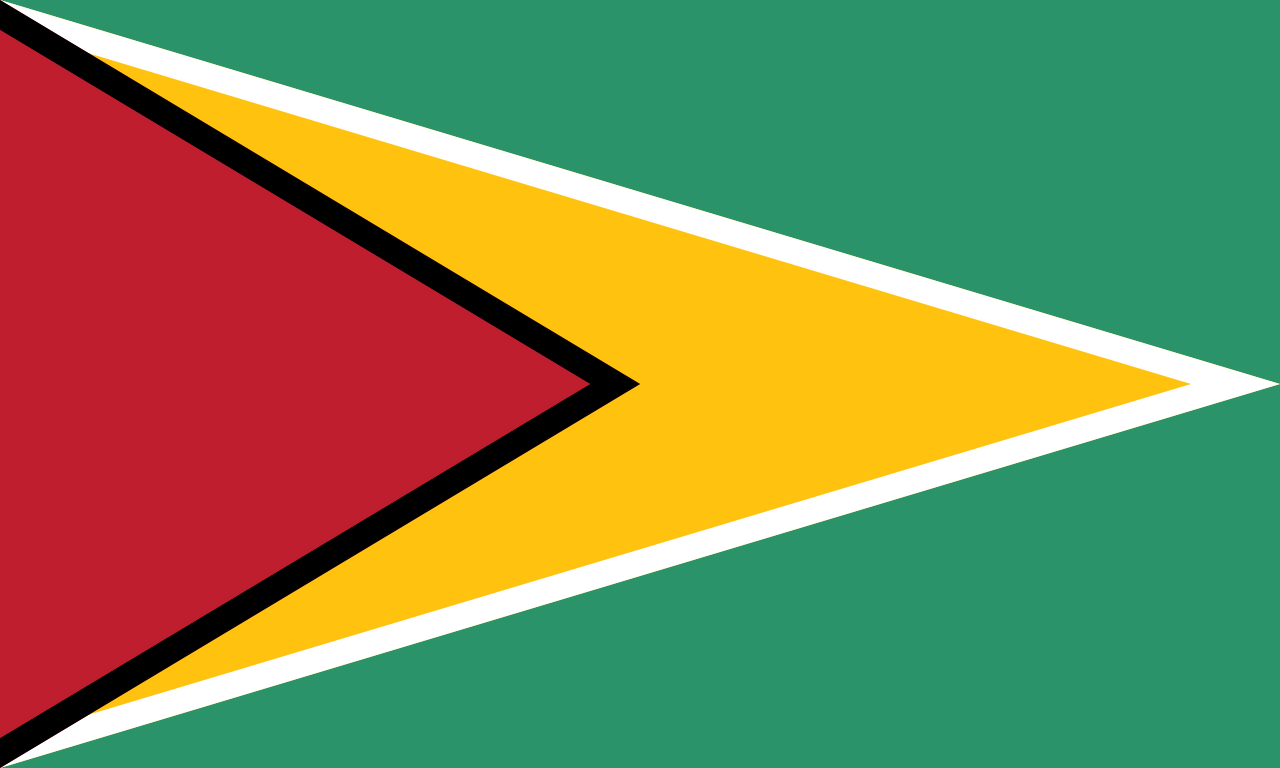
Guyana, officially the Co-operative Republic of Guyana, is a developing country on the northern coast of South America. It is bordered by the Atlantic Ocean to the north, Suriname to the east, Brazil to the south and southwest, and Venezuela to the west. It is part of The Guianas. The capital and largest city is Georgetown. With a land area of 214,969 km2 (83,000 sq mi), Guyana is the third-smallest sovereign state by area in mainland South America after Uruguay and Suriname, and is the second-least populous sovereign state in South America after Suriname; it is also one of the least densely populated countries on Earth. The official language of the country is English, although a large part of the population is bilingual in English and the Indigenous languages. Guyana is the only country in mainland South America to have English as the official language. The majority of the population also speaks Guyanese Creole, which is an English-based creole. Guyana is part of the Commonwealth Caribbean. It is part of the mainland Caribbean region maintaining strong cultural, historical, and political ties with other Caribbean countries as well as serving as the headquarters for the Caribbean Community (CARICOM). In 2008, the country joined the Union of South American Nations as a founding member. It has a wide variety of natural habitats and very high biodiversity. The country also hosts a part of the Amazon rainforest, the largest and most biodiverse tropical rainforest in the world. The region known as "the Guianas" consists of the large shield landmass north of the Amazon River and east of the Orinoco River known as the "land of many waters". Nine Indigenous tribes reside in Guyana: the Wai Wai, Macushi, Patamona, Lokono, Kalina, Wapishana, Pemon, Akawaio and Warao. Historically dominated by the Lokono and Kalina tribes, Guyana was colonised by the Dutch before coming under British control in the late 18th century. It was governed as British Guiana with a mostly plantation-style economy until the 1950s, forming part of the British West Indies. It gained independence in 1966 and officially became a republic within the Commonwealth of Nations in 1970. The legacy of British colonialism is reflected in the country's political administration, lingua franca and diverse population, which includes Indian, African, Indigenous, Chinese, Portuguese, other European, and various multiracial groups. In 2017, 41% of the population of Guyana lived below the poverty line. Guyana's economy has been undergoing a transformation since the discovery of crude oil in 2015 and commercial drilling in 2019, with its economy growing by 49% in 2020, making it, by some accounts, currently the world's fastest-growing economy. Guyana is poised to become one of the world's largest per capita oil producers by 2025, thanks to massive offshore oil discoveries. Since 2017, over 11 billion barrels of oil reserves have been found off the country's coast—the largest addition to global oil reserves since the 1970s. The crude oil production has made Guyana a major participant in international energy trade in early 2020s. Guyana is now ranked as having the fourth-highest GDP per capita in the Americas after the United States, Canada, and the Bahamas. According to the World Bank in 2023, abject poverty still exists and the country faces significant risks in structurally managing its growth.