| Die | Impression | Created | Description |
| | | 1782 | The first die was made of brass, and measured .mw- .mw- 2+1⁄16 inches (5.2 cm) in diameter while being one half inch (13 mm) thick. It was cut sometime between June and September 1782 (i.e. between the design being accepted and its first use), although the exact date is not known. The identity of the engraver is also not known; it may have been Robert Scot but Thomson may also have found a private engraver on his own. The first die depicts a relatively crude crested eagle, thin-legged and somewhat awkward. There is no fruit on the olive branch, and the engraver added a border of acanthus leaves. Depicting an eagle with a crest is typical in heraldry, but is at odds with the official blazon of the seal which specifies a bald eagle (which have no crests). The blazon does not specify the arrangement of the stars (which were randomly placed in Thomson's sketch) nor the number of points; the engraver chose six-pointed stars (typical of U.S. heraldry), and arranged them in a larger six-pointed star. No drawing made by the engraver has ever been found, and it is not known if Thomson provided any. This first die was used until 1841, and is now on display in the National Archives in Washington, D.C. There was no die made of the reverse side of the seal (and in fact, one has never been made). The intended use was for pendant seals, which are discs of wax attached to the document by a cord or ribbon, and thus have two sides. However, the United States did not use pendant seals at the time, and there was no need for a die of the reverse. In an essay published in Harper's from 1856 Bernard Lossing alluded to a version half the size for the purpose of impressing wax and paper. More recent research has not been able to verify this claim, with no record of this seal being found (although the second seal committee of 1780 had recommended a half-size seal). |
| | | 1825 | Starting with the ratification of the Treaty of Ghent, the United States began to use pendant seals on treaties, where the seal is impressed onto a separate wax disc and attached to the document with cords. Although the reverse side of the seal was designed for this purpose, a die was still not made but rather the obverse was impressed on one side only using the regular die. However, this did not conform to the European tradition of using much larger seals for treaties. To address this, Seraphim Masi of Washington D.C., was asked to design a larger seal specifically for treaties. Masi produced a quite different design, showing a much more realistic (and uncrested) eagle, turned somewhat to the side. He also added fruits to the olive branch, changed the shape of the shield, and depicted the crest differently. It was 4+11⁄16 inches (11.9 cm) in diameter. These seals were transported in metallic boxes called skippets, which protected the actual wax seal from damage. The skippets themselves also were engraved with the seal design. Several skippets were made at a time, which the State Department used as needed. Usually skippets were made out of sterling silver, though for the Japanese treaty following Commodore Perry's mission a golden box was used (the ratification of that treaty, made later in 1854, had an even more elaborate and expensive seal and heavy gold skippet). The Masi treaty die was used until 1871, almost exclusively for treaties, at which point the U.S. government discontinued the use of pendant seals. The die is also currently on display at the National Archives. Masi's company made most of the skippets for almost twenty years, after which the State Department switched to nearly identical versions made by Samuel Lewis. At least one 1871 treaty seal was actually made using a Lewis skippet mold instead of the Masi die, meaning it too is technically an official die. |
| | | 1841 | Over time, the original seal became worn and needed to be replaced. John Peter Van Ness Throop of Washington D.C. engraved a new die in 1841, which is also sometimes known as the "illegal seal" because only six arrows are shown rather than the required thirteen. Throop also chose to use five-pointed stars, though kept the six-pointed star arrangement, a change which has continued in all subsequent dies. Other changes include a more vigorous and uncrested eagle, the removal of the acanthus leaves, a general crowding of the design upward, a different shape to the shield, and fruit on the olive branch (four olives). The seal was 2+1⁄8 inches (5.4 cm) in diameter. In 1866, the first counter die was made, which is the same design in opposite relief. The paper was placed between the die and counter die, resulting in a sharper impression in the paper than from one die alone. The use of counterdies continues to this day. |
| — | | 1877 | The United States Centennial in 1876 had renewed interest in national symbols, and articles appeared noting the irregularities in the 1841 seal. However, when it came time to replace the worn 1841 die, the Department of State kept the same design. The new die was engraved by Herman Baumgarten of Washington, D.C. His version followed the 1841 die very closely, including the errors, and was the same size. The most notable differences were slightly larger stars and lettering. The workmanship on the die was relatively poor, with no impression being very clear, and it is considered the poorest of all Great Seal die. It was the one in use during the seal's centennial in 1882. |
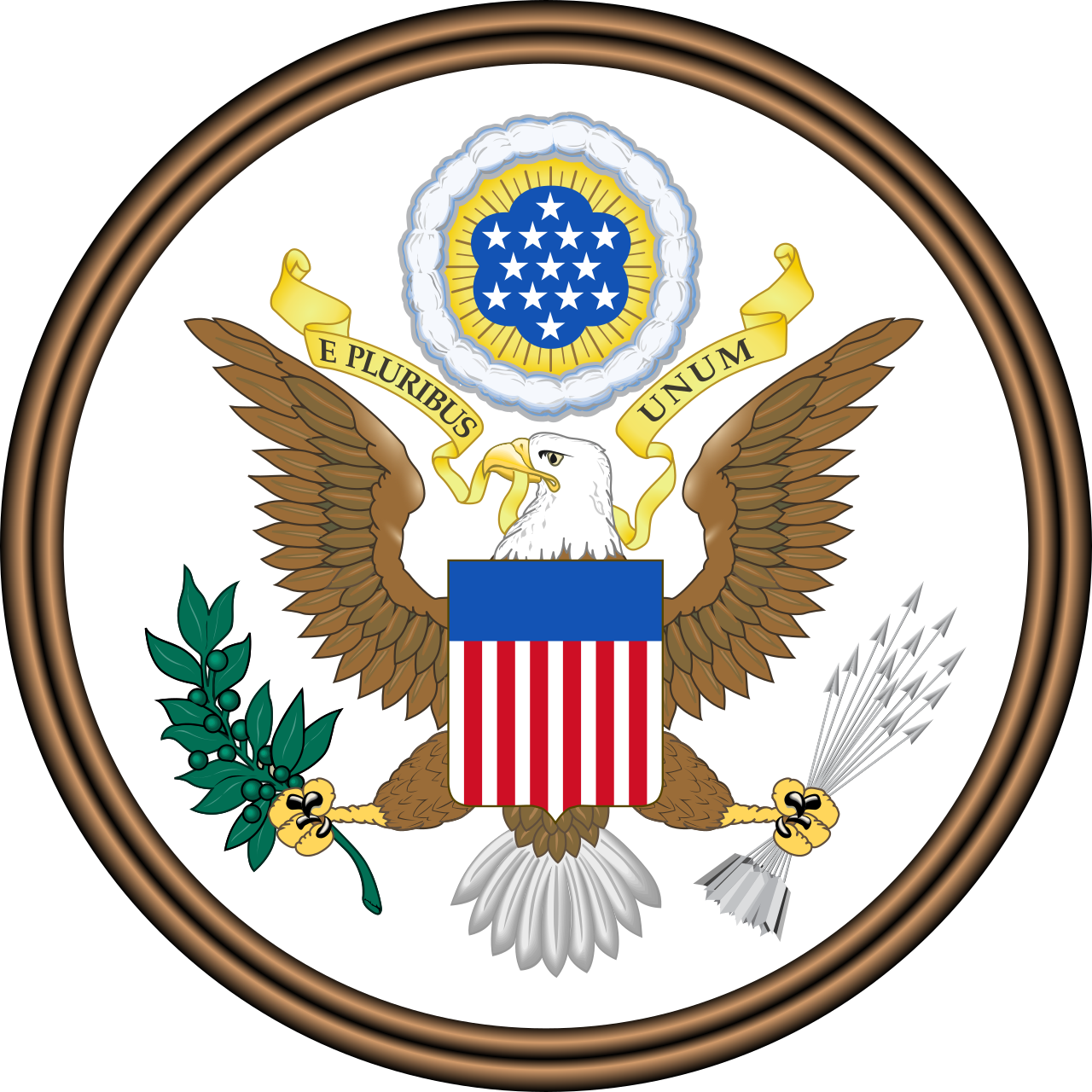
| | | 1885 | By early 1881 the State Department started responding to criticism of the seal, resulting first in an 1882 centennial commemorative medal, and then with Secretary of State Frederick Frelinghuysen asking for funds to create a new design and dies of both the obverse and reverse on January 11, 1884, after getting estimates of the cost. Congress eventually appropriated $1,000 for those purposes on July 7, 1884. The design contract went to Tiffany & Co. Theodore F. Dwight, Chief of the Bureau of Rolls and Library of the Department of State, supervised the process. He brought in several consultants to consider design from historical, heraldic, and artistic points of view. These included Justin Winsor, a historical scholar, Charles Eliot Norton, a Harvard professor, William H. Whitmore, author of Elements of Heraldry, John Denison Chaplin, Jr., an expert on engraving and associate editor of American Cyclopædia, the sculptor Augustus Saint-Gaudens, the Unitarian minister Edward Everett Hale, and even the botanist Asa Gray to help with the olive branch. Tiffany's chief designer, James Horton Whitehouse, was the artist responsible for the actual design. On December 13, 1884, following much research and discussion among the group, Whitehouse submitted his designs. The result was a much more formal and heraldic look, completely different from previous dies, and has remained essentially unchanged since. The eagle is a great deal more robust and clutches the olive branch and arrows from behind. The 13 arrows were restored, in accordance with the original law, and the olive branch was depicted with 13 leaves and 13 olives. The clouds surrounding the constellation were made a complete circle for the first time. The resulting die was made of steel, was 3 inches (76 mm) wide, and weighed one pound six ounces. In a letter accompanying their designs, Tiffany gave their reasonings behind various elements. The eagle was made as realistic as the rules of heraldry would permit, and the scroll style was chosen to least interfere with the eagle. There were no stars in the chief (the area at the top of the shield), as is sometimes seen, as there are none specified in the blazon and thus including them would violate the rules of heraldry. Some had suggested allowing the rays of the sun to extend through the clouds, as appears to be specified in the original law and sometimes seen in other versions, but Whitehouse rejected that idea and kept with the traditional die representation. He also considered adding flowers to the olive branch, but decided against it, as "the unspecified number of flowers would be assumed to mean something when it would not". Tiffany also submitted a design for the reverse of the seal, but even though Congress had ordered one a die was not created. The members of the consulting group were somewhat disparaging of the design of even the obverse, but especially critical of the reverse, and suggested not making it at all. Dwight eventually agreed and did not order the die, though he said it was "not improper" that one eventually be made. To this day, there has never been an official die made of the reverse. |
| | | 1904 | After only 17 years, the seal was no longer making a good impression (probably due to a worn counter die). On July 1, 1902, Congress passed an act to appropriate $1250 to have the seal recut. There was some discussion among State Department officials about whether to redo the design again, but given the thought that had gone into the 1885 version, it was decided to recreate that design. Congress renewed the law on March 3, 1903, since no action had yet been taken, and this time specified that it be recut from the existing model, which ended any further discussion. The die was engraved by Max Zeitler of the Philadelphia firm of Baily Banks & Biddle in 1903 (and is thus sometimes called the 1903 die), but final delivery was delayed until January 1904 due to issues with the press. There were slight differences; the impressions were sharper, the feathers more pointed, and the talons have shorter joints. Also, two small heraldic errors which had persisted on all previous seal dies were fixed: the rays of the glory were drawn with dots to indicate the tincture gold, and the background of the stars was drawn with horizontal lines to indicate azure. The die was first used on January 26, 1904, and was used for 26 years. All dies made since have followed exactly the same design, and in 1986 the Bureau of Engraving and Printing made a master die from which all future dies will be made. The current die is the seventh and was made in 1986. |