
Topzle Topzle

Gerrymandering in the United States

Updated: Wikipedia source
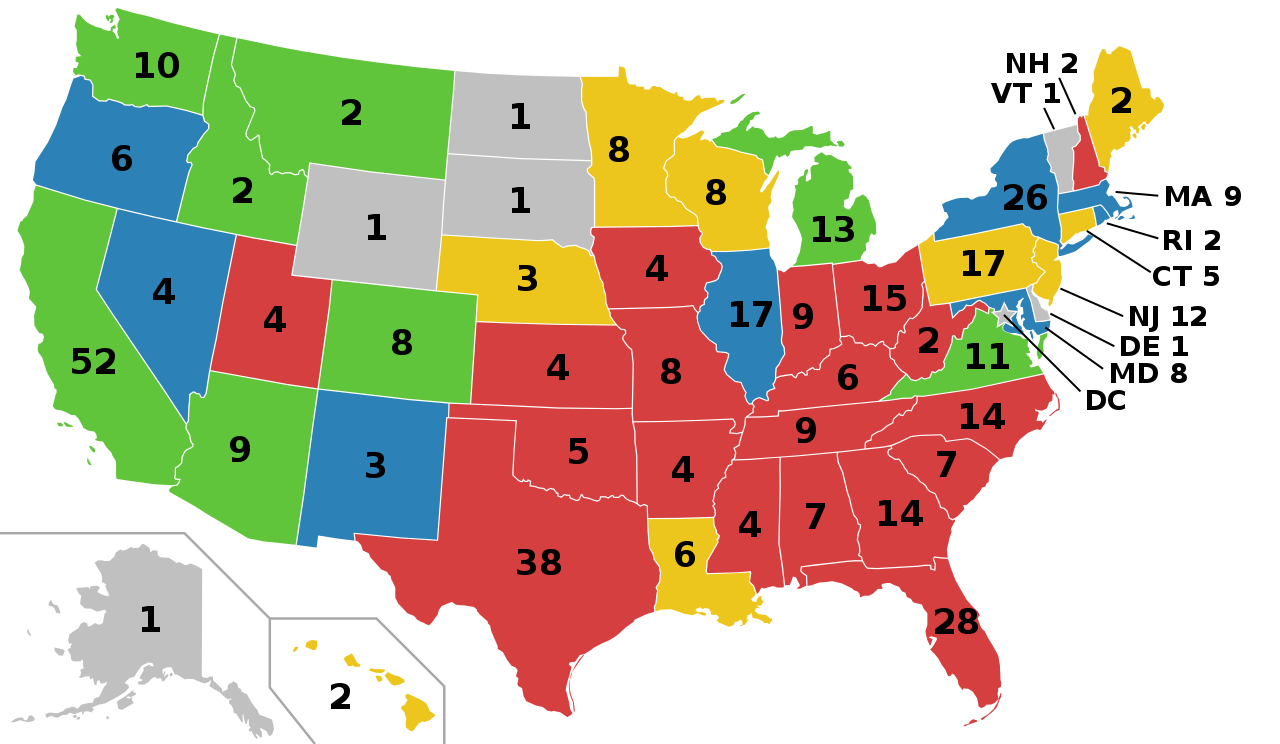
Gerrymandering in the United States

Gerrymandering is the practice of setting boundaries of electoral districts to favor specific political interests within legislative bodies, often resulting in districts with convoluted, winding boundaries rather than compact areas. The term "gerrymandering" was coined in 1812 after a review of the redistricting maps of Massachusetts set by Governor Elbridge Gerry noted that one of the districts looked like a mythical salamander. In the United States, redistricting takes place in each state about every ten years, after the decennial census. It defines geographical boundaries, with each district within a state being geographically contiguous and having about the same number of state voters. The resulting map affects the elections of the state's members of the United States House of Representatives and the state legislative bodies. Redistricting has always been regarded as a political exercise. In most states, it is controlled by state legislatures and sometimes the governor. In some states the governor has no veto power over redistricting legislation, while in some states the veto override threshold is a simple majority. In some states, an independent commission is tasked with drawing district boundaries. When one party controls the state's legislative bodies and governor's office, it is in a strong position to gerrymander district boundaries to advantage its side and to disadvantage its political opponents. Since 2010, detailed maps and high-speed computing have facilitated gerrymandering by political parties in the redistricting process in order to gain control of the state legislature and congressional representation and potentially to maintain that control over several decades, even against shifting political changes in a state's population. The Supreme Court of the United States has often struggled when partisan gerrymandering occurs such as in Vieth v. Jubelirer (2004) and Gill v. Whitford (2018). Typical gerrymandering cases in the United States take the form of partisan gerrymandering, which is aimed at favoring one political party while weakening another; bipartisan gerrymandering, which is aimed at protecting incumbents by multiple political parties; and racial gerrymandering, which is aimed at maximizing or minimizing the impact of certain racial groups. In the past, federal courts have deemed extreme cases of gerrymandering to be unconstitutional, but have struggled with how to define the types of gerrymandering and the standards that should be used to determine which redistricting maps are unconstitutional. In 1995 the Supreme Court came to a 5–4 decision during Miller v. Johnson that racial gerrymandering is a violation of constitutional rights and upheld decisions against redistricting that is purposely devised based on race. Racial gerrymandering effectively maximizes or minimizes the impact of racial minority votes in certain districts. Racial gerrymandering may be created without considerations of party lines but often redraw or reconstruct districts in ways that limit minority voters to smaller or a reduced number of districts. The effect of the Supreme Court's 2013 decision in Shelby County v. Holder on the Voting Rights Act of 1965, the rapid improvement of technology and the influx of dark money into redistricting are also possible factors that may impact the voting power of minorities. A 5–4 decision by the court in Rucho v. Common Cause (2019), stated that questions of gerrymandering represented a nonjusticiable political question which could not be dealt with by the federal court system and ultimately left it back to states and to Congress to develop remedies to challenge and to prevent gerrymandering.

Tables

· Inclusion of prisons › Reform efforts
California
California
State
California
Prohibition passed
2011
First census affected
2020
Colorado
Colorado
State
Colorado
Prohibition passed
2020
Municipalities and counties
2002
First census affected
2020
Connecticut
Connecticut
State
Connecticut
Prohibition passed
2021
First census affected
2020
Delaware
Delaware
State
Delaware
Prohibition passed
2010
First census affected
2020
Illinois
Illinois
State
Illinois
Prohibition passed
2021
First census affected
2030
Maryland
Maryland
State
Maryland
Prohibition passed
2010
First census affected
2010
Michigan
Michigan
State
Michigan
Municipalities and counties
1966
Minnesota
Minnesota
State
Minnesota
Prohibition passed
2024
Montana
Montana
State
Montana
Prohibition passed
2023
Redistricting committee passed
2021
First census affected
2020
Nevada
Nevada
State
Nevada
Prohibition passed
2019
First census affected
2020
New Jersey
New Jersey
State
New Jersey
Prohibition passed
2020
First census affected
2020
New York
New York
State
New York
First census affected
2010
Pennsylvania
Pennsylvania
State
Pennsylvania
Redistricting committee passed
2021
First census affected
2020
Rhode Island
Rhode Island
State
Rhode Island
Redistricting committee passed
2022
First census affected
2020
Tennessee
Tennessee
State
Tennessee
Municipalities and counties
2016
Virginia
Virginia
State
Virginia
Prohibition passed
2020
Municipalities and counties
2013
First census affected
2020
Washington
Washington
State
Washington
Prohibition passed
2019
First census affected
2020
State
Prohibition passed
Redistricting committee passed
Municipalities and counties
First census affected
California
2011
2020
Colorado
2020
2002
2020
Connecticut
2021
2020
Delaware
2010
2020
Illinois
2021
2030
Maryland
2010
2010
Michigan
1966
Minnesota
2024
Montana
2023
2021
2020
Nevada
2019
2020
New Jersey
2020
2020
New York
2010
Pennsylvania
2021
2020
Rhode Island
2022
2020
Tennessee
2016
Virginia
2020
2013
2020
Washington
2019
2020
· Effects › Gerrymandering and the 2018 midterm elections
North Carolina
North Carolina
State
North Carolina
% D vote
48 %
% R vote
50 %
% D seats
23 %
% R seats
76 %
Total seats
13
Difference between D
−25 %
Difference between R
26 %
Ohio
Ohio
State
Ohio
% D vote
47 %
% R vote
52 %
% D seats
25%
% R seats
75%
Total seats
16
Difference between D
−22 %
Difference between R
22 %
Wisconsin
Wisconsin
State
Wisconsin
% D vote
53 %
% R vote
45 %
% D seats
37 %
% R seats
62 %
Total seats
8
Difference between D
−15 %
Difference between R
16 %
State
% D vote
% R vote
% D seats
% R seats
Total seats
Difference between D
Difference between R
North Carolina
48 %
50 %
23 %
76 %
13
−25 %
26 %
Ohio
47 %
52 %
25%
75%
16
−22 %
22 %
Wisconsin
53 %
45 %
37 %
62 %
8
−15 %
16 %
· Examples of gerrymandered U . districts
California's 23rd congressional district was an example of packing confined to a narrow strip of coast drawn from three large counties. The district shown was radically redrawn by California's non-partisan commission after the 2010 census.
North Carolina's 12th congressional district between 2003 and 2016 was an example of packing. The district has predominantly African-American residents who vote for Democrats.
California's 23rd congressional district was an example of packing confined to a narrow strip of coast drawn from three large counties. The district shown was radically redrawn by California's non-partisan commission after the 2010 census.
California's 11th congressional district featured long, strained projections and counter-projections of other districts, achieving mild but reliable packing. The district comprised a selection of people and communities favorable to the Republican Party. It was redrawn from the version shown after the 2010 census.
Col 1
North Carolina's 12th congressional district between 2003 and 2016 was an example of packing. The district has predominantly African-American residents who vote for Democrats.
California's 11th congressional district featured long, strained projections and counter-projections of other districts, achieving mild but reliable packing. The district comprised a selection of people and communities favorable to the Republican Party. It was redrawn from the version shown after the 2010 census.
Bi-partisan incumbent gerrymandering produced California's 38th congressional district, home to Grace Napolitano, a Democrat, who ran unopposed in 2004. This district was redrawn by California's non-partisan commission after the 2010 census.
Col 1
North Carolina's 12th congressional district between 2003 and 2016 was an example of packing. The district has predominantly African-American residents who vote for Democrats.
Bi-partisan incumbent gerrymandering produced California's 38th congressional district, home to Grace Napolitano, a Democrat, who ran unopposed in 2004. This district was redrawn by California's non-partisan commission after the 2010 census.
Texas's controversial 2003 partisan gerrymander produced Texas District 22 for former Rep. Tom DeLay, a Republican. A packed seat of Republicans based on past results of its many voting districts, it features two necks and a counter-projection.
Col 1
North Carolina's 12th congressional district between 2003 and 2016 was an example of packing. The district has predominantly African-American residents who vote for Democrats.
Texas's controversial 2003 partisan gerrymander produced Texas District 22 for former Rep. Tom DeLay, a Republican. A packed seat of Republicans based on past results of its many voting districts, it features two necks and a counter-projection.
The odd shapes – distended projections and non-natural feature-based wiggly boundaries – of California Senate districts in southern California (2008) have led to complaints of gerrymandering.
Col 1
North Carolina's 12th congressional district between 2003 and 2016 was an example of packing. The district has predominantly African-American residents who vote for Democrats.
The odd shapes – distended projections and non-natural feature-based wiggly boundaries – of California Senate districts in southern California (2008) have led to complaints of gerrymandering.
Illinois's 4th congressional district has the moniker "the earmuffs" and amounts to packing of two mainly Hispanic areas. It has had in relative terms hairline contiguity along Interstate 294 and two necks at right angles, forming a very long neck between two areas, which was somewhat widened in 2013.
Col 1
North Carolina's 12th congressional district between 2003 and 2016 was an example of packing. The district has predominantly African-American residents who vote for Democrats.
Illinois's 4th congressional district has the moniker "the earmuffs" and amounts to packing of two mainly Hispanic areas. It has had in relative terms hairline contiguity along Interstate 294 and two necks at right angles, forming a very long neck between two areas, which was somewhat widened in 2013.
After the Democrat Jim Matheson was elected in 2000, the Utah legislature redrew the 2nd congressional district to favor future Republican majorities. The predominantly Democratic city of Salt Lake City was connected to predominantly Republican eastern and southern Utah through a thin sliver of land running through Utah County. Nevertheless, Mathes
Col 1
North Carolina's 12th congressional district between 2003 and 2016 was an example of packing. The district has predominantly African-American residents who vote for Democrats.
After the Democrat Jim Matheson was elected in 2000, the Utah legislature redrew the 2nd congressional district to favor future Republican majorities. The predominantly Democratic city of Salt Lake City was connected to predominantly Republican eastern and southern Utah through a thin sliver of land running through Utah County. Nevertheless, Mathes
Illinois's 17th congressional district in the western portion of the state was gerrymandered: the major urban centers are anchored and Decatur is included, although nearly isolated from the main district. It was redrawn in 2013.
Col 1
North Carolina's 12th congressional district between 2003 and 2016 was an example of packing. The district has predominantly African-American residents who vote for Democrats.
Illinois's 17th congressional district in the western portion of the state was gerrymandered: the major urban centers are anchored and Decatur is included, although nearly isolated from the main district. It was redrawn in 2013.
Maryland's 3rd congressional district was listed in the top ten of the most gerrymandered districts in the United States by The Washington Post in 2014. The district is drawn to favor Democratic candidates. Former MD-3 representative John Sarbanes has put forth the For the People Act of 2019 aimed at U . electoral reform to address partisan gerrym
Col 1
North Carolina's 12th congressional district between 2003 and 2016 was an example of packing. The district has predominantly African-American residents who vote for Democrats.
Maryland's 3rd congressional district was listed in the top ten of the most gerrymandered districts in the United States by The Washington Post in 2014. The district is drawn to favor Democratic candidates. Former MD-3 representative John Sarbanes has put forth the For the People Act of 2019 aimed at U . electoral reform to address partisan gerrym
North Carolina's 4th congressional district encompassed parts of Raleigh, Hillsborough, and the entirety of Chapel Hill. The district was considered to be one of the most gerrymandered districts in North Carolina and the United States as a whole. The district was redrawn in 2017.
Col 1
North Carolina's 12th congressional district between 2003 and 2016 was an example of packing. The district has predominantly African-American residents who vote for Democrats.
North Carolina's 4th congressional district encompassed parts of Raleigh, Hillsborough, and the entirety of Chapel Hill. The district was considered to be one of the most gerrymandered districts in North Carolina and the United States as a whole. The district was redrawn in 2017.
Pennsylvania's 7th congressional district, which was drawn to create a district favorable to Republicans within the Philadelphia suburbs, became known as "Goofy Kicking Donald Duck" due to its distorted shape. At one point being only as wide as a parking lot, it was ruled unconstitutional by the Supreme Court of Pennsylvania in 2018.
Col 1
North Carolina's 12th congressional district between 2003 and 2016 was an example of packing. The district has predominantly African-American residents who vote for Democrats.
Pennsylvania's 7th congressional district, which was drawn to create a district favorable to Republicans within the Philadelphia suburbs, became known as "Goofy Kicking Donald Duck" due to its distorted shape. At one point being only as wide as a parking lot, it was ruled unconstitutional by the Supreme Court of Pennsylvania in 2018.
North Carolina's 12th congressional district between 2003 and 2016 was an example of packing. The district has predominantly African-American residents who vote for Democrats.
California's 23rd congressional district was an example of packing confined to a narrow strip of coast drawn from three large counties. The district shown was radically redrawn by California's non-partisan commission after the 2010 census.
California's 11th congressional district featured long, strained projections and counter-projections of other districts, achieving mild but reliable packing. The district comprised a selection of people and communities favorable to the Republican Party. It was redrawn from the version shown after the 2010 census.
Bi-partisan incumbent gerrymandering produced California's 38th congressional district, home to Grace Napolitano, a Democrat, who ran unopposed in 2004. This district was redrawn by California's non-partisan commission after the 2010 census.
Texas's controversial 2003 partisan gerrymander produced Texas District 22 for former Rep. Tom DeLay, a Republican. A packed seat of Republicans based on past results of its many voting districts, it features two necks and a counter-projection.
The odd shapes – distended projections and non-natural feature-based wiggly boundaries – of California Senate districts in southern California (2008) have led to complaints of gerrymandering.
Illinois's 4th congressional district has the moniker "the earmuffs" and amounts to packing of two mainly Hispanic areas. It has had in relative terms hairline contiguity along Interstate 294 and two necks at right angles, forming a very long neck between two areas, which was somewhat widened in 2013.
After the Democrat Jim Matheson was elected in 2000, the Utah legislature redrew the 2nd congressional district to favor future Republican majorities. The predominantly Democratic city of Salt Lake City was connected to predominantly Republican eastern and southern Utah through a thin sliver of land running through Utah County. Nevertheless, Mathes
Illinois's 17th congressional district in the western portion of the state was gerrymandered: the major urban centers are anchored and Decatur is included, although nearly isolated from the main district. It was redrawn in 2013.
Maryland's 3rd congressional district was listed in the top ten of the most gerrymandered districts in the United States by The Washington Post in 2014. The district is drawn to favor Democratic candidates. Former MD-3 representative John Sarbanes has put forth the For the People Act of 2019 aimed at U . electoral reform to address partisan gerrym
North Carolina's 4th congressional district encompassed parts of Raleigh, Hillsborough, and the entirety of Chapel Hill. The district was considered to be one of the most gerrymandered districts in North Carolina and the United States as a whole. The district was redrawn in 2017.
Pennsylvania's 7th congressional district, which was drawn to create a district favorable to Republicans within the Philadelphia suburbs, became known as "Goofy Kicking Donald Duck" due to its distorted shape. At one point being only as wide as a parking lot, it was ruled unconstitutional by the Supreme Court of Pennsylvania in 2018.

References

  1. Here are the most obscenely gerrymandered congressional districts in America
    https://edition.cnn.com/2017/10/03/politics/redistricting-supreme-court-gerrymandered/index.html
  2. The Washington Post
    https://www.washingtonpost.com/news/wonk/wp/2016/06/09/how-a-widespread-practice-to-politically-empower-african-americans-might-actually-harm-them/
  3. LII / Legal Information Institute
    https://www.law.cornell.edu/constitution-conan/amendment-14/section-1/racial-vote-dilution-and-racial-gerrymandering
  4. ProPublica
    https://www.propublica.org/article/partisan-gerrymandering-is-still-about-race
  5. Labunski, Richard. James Madison and the Struggle for the Bill of Rights, New York: Oxford University Press, 2006
  6. Early American Studies
    https://www.jstor.org/stable/23546676
  7. The Rise and Development of the Gerrymander
    https://archive.org/details/risedevelopmento00grif
  8. Political Geography
    https://doi.org/10.1016%2Fj.polgeo.2008.09.003
  9. Thomas B. Hofeller, "The Looming Redistricting Reform; How will the Republican Party Fare?", Politico, 2011.
    https://www.politico.com/pdf/PPM116_rnc_hofeller_memo_051010.pdf
  10. National Journal
    https://web.archive.org/web/20120116031011/http://www.nationaljournal.com/politics/-perrymander-redistricting-map-that-rick-perry-signed-has-texas-hispanics-up-in-arms-20110819
  11. CBS News
    https://www.cbsnews.com/news/redistricting-journal-showdown-in-texas-reasons-and-implications-for-the-house-and-hispanic-vote/
  12. Annual Review of Political Science
    https://doi.org/10.1146%2Fannurev-polisci-060118-045351
  13. The New York Times
    https://www.nytimes.com/2017/10/06/opinion/sunday/computers-gerrymandering-wisconsin.html
  14. The New York Times
    https://www.nytimes.com/2017/08/29/magazine/the-new-front-in-the-gerrymandering-wars-democracy-vs-math.html
  15. University of Delaware
    https://web.archive.org/web/20190111221509/http://www1.udel.edu/johnmack/research/gerrymandering.pdf
  16. Redistricting and Representation: Why Competitive Elections Are Bad for America
    https://books.google.com/books?id=Kz7TzrY7xr0C&q=%22mascara%20had%20represented%22&pg=PA69
  17. "Republican Party Politics (Part II)"
    https://web.archive.org/web/20020520185434/http://wcpo.com/wcpo/localshows/iteam/cdd905.html
  18. "United States, Presidential Election, 2 November 2004: Final Report"
    http://www.osce.org/odihr/elections/usa/14028
  19. The Atlantic
    https://www.theatlantic.com/politics/archive/2017/10/gerrymandering-technology-redmap-2020/543888/
  20. Brennan Center
    https://www.brennancenter.org/our-work/research-reports/gerrymandering-explained
Image
Source:
Tip: Wheel or +/− to zoom, drag to pan, Esc to close.