
Topzle Topzle

Gallipoli campaign

Updated: Wikipedia source
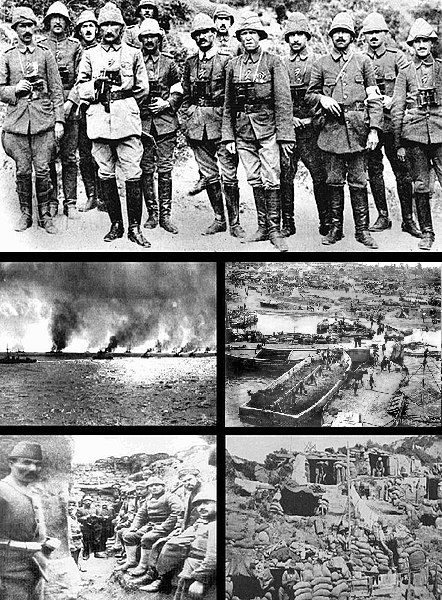
Gallipoli campaign

The Gallipoli campaign, the Dardanelles campaign, the Defence of Gallipoli or the Battle of Gallipoli (Turkish: Gelibolu Muharebesi, Çanakkale Muharebeleri or Çanakkale Savaşı) was a military campaign in the First World War on the Gallipoli Peninsula (now Gelibolu) from 19 February 1915 to 9 January 1916. The Allied powers (Britain, France and the Russian Empire) unsuccessfully attempted to make the Ottoman Empire, one of the Central Powers, capitulate by taking control of the Turkish straits. They intended to expose the Ottoman capital at Constantinople to bombardment by Allied warships and cut it off from the Asian part of the empire. An Ottoman Empire defeat could have led to unfettered Western control of the Suez Canal and the opening of the Bosphorus and Dardanelles straits to Allied supplies headed for the Black Sea and warm-water ports in Russia. In February 1915, the Allied fleet failed to force a passage through the Dardanelles. An amphibious landing on the Gallipoli peninsula began in April 1915. In January 1916, after eight months' fighting, with approximately 250,000 casualties on each side, the land campaign was abandoned and the invasion force was withdrawn. It was a costly campaign for the Allied powers and the Ottoman Empire as well as for the sponsors of the expedition, especially the First Lord of the Admiralty (1911–1915), Winston Churchill. The campaign is considered a Turkish victory. In Turkey, it is regarded as a defining moment in the country's history. Mustafa Kemal Atatürk, who rose to prominence as a commander at Gallipoli, became the founder and first president of the Republic of Turkey in 1923. The campaign is considered by some to be the beginning of Australian and New Zealand national consciousness. The anniversary of the landings, 25 April, is known as Anzac Day, the most significant commemoration of military casualties and veterans in the two countries, surpassing Remembrance Day (Armistice Day).

Infobox

Date
19 February 1915 – 9 January 1916 (10 months, 3 weeks and 2 days)
Location
Gallipoli Peninsula, Sanjak of Gelibolu, Adrianople Vilayet, Ottoman Empire (modern-day Gelibolu, Çanakkale, Turkey)40°14′15″N 26°16′39″E / 40 °N 26 °E / 40 ; 26
Result
Ottoman victory

Tables

Gallipoli casualties (not including illness) · Aftermath › Casualties
Ottoman Empire
Ottoman Empire
Countries
Ottoman Empire
Dead
56,643
Wounded
97,007
Missing or POW
11,178
Total
164,828
United Kingdom
United Kingdom
Countries
United Kingdom
Dead
34,072
Wounded
78,520
Missing or POW
7,654
Total
120,246
France
France
Countries
France
Dead
9,798
Wounded
17,371
Missing or POW
Total
27,169
Australia
Australia
Countries
Australia
Dead
8,709
Wounded
19,441
Missing or POW
Total
28,150
New Zealand
New Zealand
Countries
New Zealand
Dead
2,721
Wounded
4,752
Missing or POW
Total
7,473
British India
British India
Countries
British India
Dead
1,358
Wounded
3,421
Missing or POW
Total
4,779
Newfoundland
Newfoundland
Countries
Newfoundland
Dead
49
Wounded
93
Missing or POW
Total
142
Total (Entente)
Total (Entente)
Countries
Total (Entente)
Dead
56,707
Wounded
123,598
Missing or POW
7,654
Total
187,959
Countries
Dead
Wounded
Missing or POW
Total
Ottoman Empire
56,643
97,007
11,178
164,828
United Kingdom
34,072
78,520
7,654
120,246
France
9,798
17,371
27,169
Australia
8,709
19,441
28,150
New Zealand
2,721
4,752
7,473
British India
1,358
3,421
4,779
Newfoundland
49
93
142
Total (Entente)
56,707
123,598
7,654
187,959

References

  1. 198,340 British casualties (31,389 killed), 47,798 French casualties (9,798 killed or missing), 27,209 Australian casual
  2. Battleships: Royal Navy (British) HMS Ocean (1898) sunk HMS Irresistible (1898) sunk HMS Majestic (1895) sunk HMS Goliat
  3. Lower estimate of deaths are based on the Ottoman archives and the higher estimate of 87,000 on modern, western sources.
  4. (295 sailors killed).
  5. The operation would be complicated by having only five divisions, the rugged terrain of the peninsula, the small number
  6. It is debated if the Turkish forces defending the beach had machine-guns. According to Turkish historical documents the
  7. The 57th Regiment was not rebuilt and was not recreated in the Ottoman Army.
  8. The events of the day later gained significance, due to the loss of a company of the Norfolk Regiment. Having been recru
  9. The enormous casualties at Gallipoli among Irish soldiers who had volunteered to fight in the British Army was a causal
  10. Appendix 5 of the French official history (AFGG 8,1) has a one page table that not only splits these into subcategory co
  11. In November 1918, the Canterbury Mounted Rifles and the 7th Light Horse from the Anzac Mounted Division, were sent to Ga
  12. Travers 2001, p. 13; Prigge 2017, pp. 16–17, 54–56.
  13. Jung 2003, pp. 42–43.
  14. Haythornthwaite 2004, pp. 15–16.
  15. Aspinall-Oglander 1929, p. 395.
  16. Prigge 2017, pp. 16–17, 44–47, 55–56.
  17. Erickson 2001a, p. 94; Kersnovsky 1938, p. 547.
  18. Erickson 2001a, pp. 94–95.
  19. "List of Allied warships that served at Gallipoli"
    https://en.wikipedia.org/wiki/List_of_Allied_warships_that_served_at_Gallipoli
  20. Kersnovsky 1938, p. 547.
Image
Source:
Tip: Wheel or +/− to zoom, drag to pan, Esc to close.