
Topzle Topzle

Flags of the Confederate States of America

Updated: Wikipedia source
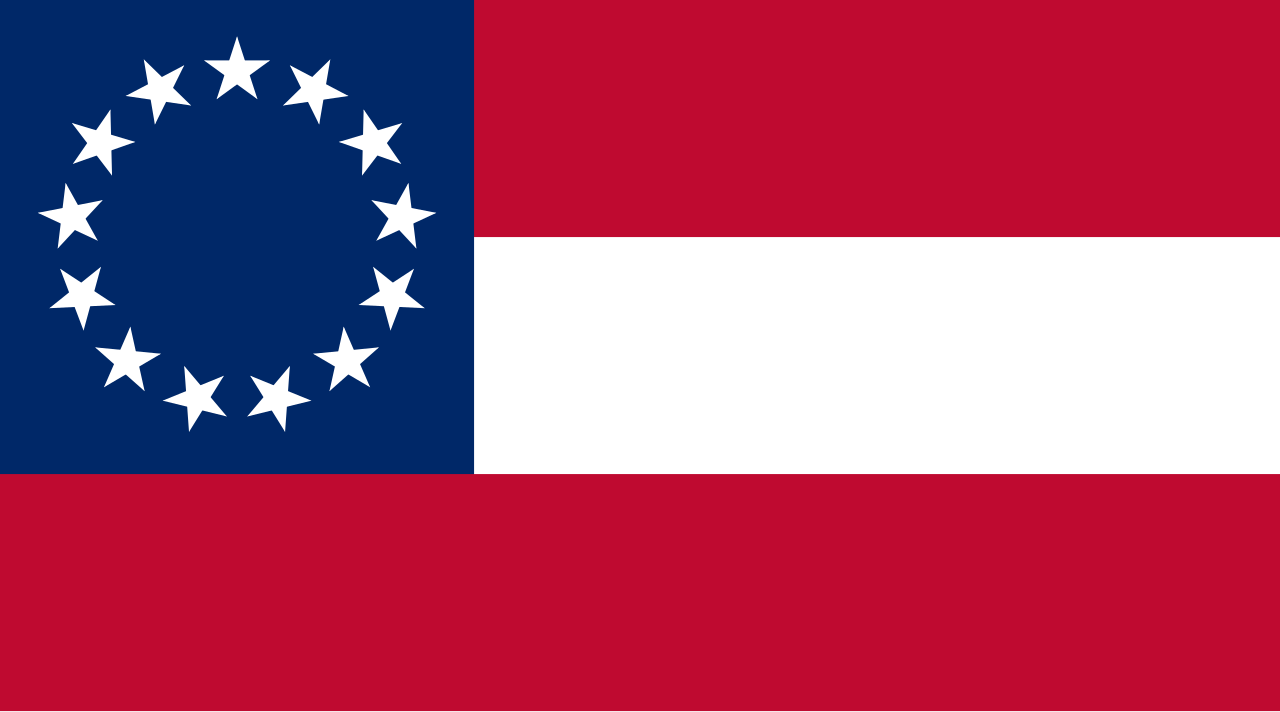
Flags of the Confederate States of America

The flags of the Confederate States of America have a history of three successive designs during the American Civil War. The flags were known as the "Stars and Bars", used from 1861 to 1863; the "Stainless Banner", used from 1863 to 1865; and the "Blood-Stained Banner", used in 1865 shortly before the Confederacy's dissolution. A rejected national flag design was also used as a battle flag by the Confederate Army and featured in the "Stainless Banner" and "Blood-Stained Banner" designs. Although this design was never a national flag, it is the most commonly-recognized symbol of the Confederacy. Following the end of the American Civil War, private and official use of the Confederate flags, particularly the battle flag, has continued amid philosophical, political, cultural, and racial controversy in the United States. These include flags displayed in states; cities, towns and counties; schools, colleges and universities; private organizations and associations; and individuals. The battle flag was also featured in the state flags of Georgia and Mississippi, although it was removed by Georgia in 2003 and Mississippi in 2020. However, the new design of the Georgia flag still references the original "Stars and Bars" iteration of the Georgia flag. After the Georgia flag was changed in 2001, the city of Trenton, Georgia, has used a flag design nearly identical to the previous version with the battle flag. It is estimated that 500–544 flags were captured during the war by the Union. The flags were sent to the War Department in Washington.

Infobox

Use
National flag
Proportion
2:3
Adopted
March 4, 1865
Design
A white rectangle, one-and-a-half times as wide as it is tall, a red vertical stripe on the far right of the rectangle, a red quadrilateral in the canton, inside the canton is a blue saltire with white outlining, with thirteen white five-pointed stars of equal size inside the saltire.
Designed by
Maj. Arthur L. Rogers

Tables

· Second flag: the "Stainless Banner" (1863–1865)
Second national flag (May 1, 1863 – March 4, 1865), 2:1 ratio
Col 1
Second national flag (May 1, 1863 – March 4, 1865), 2:1 ratio
Col 2
Second national flag (May 1, 1863 – March 4, 1865) as commonly manufactured, with a 3:2 ratio
Col 3
A 12-star variant of the "Stainless Banner" produced in Mobile, Alabama
Col 4
Variant captured following the Battle of Painesville, 1865
Col 5
Garrison flag of Fort Fisher, the "Southern Gibraltar"
Second national flag (May 1, 1863 – March 4, 1865), 2:1 ratio
Second national flag (May 1, 1863 – March 4, 1865) as commonly manufactured, with a 3:2 ratio
A 12-star variant of the "Stainless Banner" produced in Mobile, Alabama
Variant captured following the Battle of Painesville, 1865
Garrison flag of Fort Fisher, the "Southern Gibraltar"
· Third flag: the "Blood-Stained Banner" (1865)
Third national flag (after March 4, 1865)
Col 1
Third national flag (after March 4, 1865)
Col 2
Third national flag as commonly manufactured, with a square canton
Col 3
Third national flag variant produced from an example of the second national flag
Col 4
A 12-star variant of the "Blood-Stained Banner" produced in Mobile, Alabama
Third national flag (after March 4, 1865)
Third national flag as commonly manufactured, with a square canton
Third national flag variant produced from an example of the second national flag
A 12-star variant of the "Blood-Stained Banner" produced in Mobile, Alabama

References

  1. William Tappan Thompson, editor of Savannah's Daily Morning News, used a different nickname for the flag, calling it "Th
  2. Although the officially specified proportions were 1:2, many of the flags that actually ended up being produced used a 1
  3. Although the officially designated design specified a rectangular canton, many of the flags that ended up being produced
  4. Catherine Stratton Ladd is said to have designed the first Confederate flag.
  5. Neither state voted to secede or ever came under full Confederate control. Nonetheless both were still represented in th
  6. "A surviving Georgia flag in the collection of the Museum of the Confederacy in Richmond . . . places the arms on a red
  7. "Despite . . . inaction of the Tennessee legislature, the flag recommended by Senator [Tazewell B.] Newman did see some
  8. Preble 1872, pp. 414–417
  9. Preble 1880, pp. 523–525
  10. Coski 2013. "A handful of contemporaries linked the new flag design to the "peculiar institution" that was at the heart
  11. Daily Morning News
  12. Daily Morning News
  13. Daily Morning News
  14. The Confederate and Neo Confederate Reader: The Great Truth about the 'Lost Cause'
    https://web.archive.org/web/20131213161623/http://www.upress.state.ms.us/books/1338
  15. Los Angeles Times
    https://web.archive.org/web/20150712023515/http://www.latimes.com/visuals/graphics/la-na-g-confederate-flag-history-20150623-htmlstory.html
  16. Stevens-Davis and allied families: a memorial volume of history, biography, and genealogy
    https://books.google.com/books?id=VkZVAAAAMAAJ&pg=PA44
  17. Atlanta Rising: The Invention of an International City 1946–1996
    https://books.google.com/books?id=-UgsxY0tm_8C&pg=PA67
  18. "The Second Confederate National Flag (Flags of the Confederacy)"
    https://web.archive.org/web/20090209190749/http://www.confederateflags.org/national/FOTCsbr.htm
  19. "The Third Confederate National Flag (Flags of the Confederacy)"
    https://web.archive.org/web/20090130091945/http://www.confederateflags.org/national/FOTC3dnat.htm
  20. Coski 2005, pp. 17–18
Image
Source:
Tip: Wheel or +/− to zoom, drag to pan, Esc to close.