Topzle Topzle

Chrysopelea

Updated: Wikipedia source

Chrysopelea

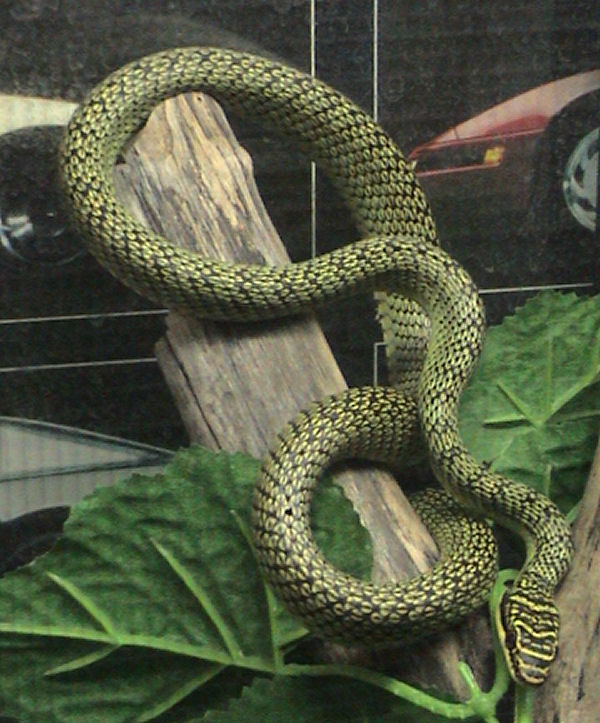
Chrysopelea is a genus of snakes, commonly known as flying snakes or gliding snakes, that belong to the family Colubridae. Chrysopelea species are found in Southeast Asia, and are known for their ability to glide between trees. Flying snakes are mildly venomous, though the venom is dangerous only to their small prey. There are five species within the genus.

Tables

· Taxonomy › Species
Chrysopelea ornata (Shaw, 1802)
Scientific name
Chrysopelea ornata (Shaw, 1802)
Common name
Golden tree snake or ornate flying snake
Description
This is the largest species of flying snake, reaching up to four feet in length. Though it is called the golden tree snake, there are other colour variations; for example, some phases tend to lean towards lime green in colour rather than pure yellow, while in India, it has orange to red markings and small black bars on the dorsum, almost as rich in colouration as the paradise tree snake. Due to their size, their gliding ability is considered weak.
Distribution
South and Southeast Asia
Chrysopelea paradisi (Boie and Boie, 1827)
Scientific name
Chrysopelea paradisi (Boie and Boie, 1827)
Common name
Paradise tree snake
Description
This flying snake species reaches up to three feet in length and is popular in the European pet trade. Their bodies are black, but covered in rich green scales. Clusters of red, orange, and yellow-coloured scales in the shape of flower petals line the dorsal area from the base of the neck to the tail. This is the most well known colouration, but some specimens may exhibit fully green colouration without any bright dorsal markings. Their gliding ability is considered one of the best among the flying snakes.
Distribution
Southeastern Asia
Chrysopelea pelias (Linnaeus, 1758)
Scientific name
Chrysopelea pelias (Linnaeus, 1758)
Common name
Twin-barred tree snake or banded flying snake
Description
This is the smallest flying snake species, reaching up to two feet in length. Its base colour is black or dark grey, and the entire body is covered with thick red and thin yellow with black bands. They also have cream-coloured ventrolateral lines, while the ventrals are pale green. While it is tiny, it is undoubtedly one of the rarest flying snake species within its range. Although it is able to move horizontally through the air when gliding, it does not glide as well as C. paradisi.
Distribution
Southeast Asia
Chrysopelea rhodopleuron (Boie, 1827)
Scientific name
Chrysopelea rhodopleuron (Boie, 1827)
Common name
Moluccan flying snake
Distribution
Ambon and Sulawesi in Indonesia
Chrysopelea taprobanica (Smith, 1943)
Scientific name
Chrysopelea taprobanica (Smith, 1943)
Common name
Sri Lankan flying snake
Distribution
Sri Lanka, Peninsular India
Image
Scientific name
Common name
Description
Distribution
Chrysopelea ornata (Shaw, 1802)
Golden tree snake or ornate flying snake
This is the largest species of flying snake, reaching up to four feet in length. Though it is called the golden tree snake, there are other colour variations; for example, some phases tend to lean towards lime green in colour rather than pure yellow, while in India, it has orange to red markings and small black bars on the dorsum, almost as rich in colouration as the paradise tree snake. Due to their size, their gliding ability is considered weak.
South and Southeast Asia
Chrysopelea paradisi (Boie and Boie, 1827)
Paradise tree snake
This flying snake species reaches up to three feet in length and is popular in the European pet trade. Their bodies are black, but covered in rich green scales. Clusters of red, orange, and yellow-coloured scales in the shape of flower petals line the dorsal area from the base of the neck to the tail. This is the most well known colouration, but some specimens may exhibit fully green colouration without any bright dorsal markings. Their gliding ability is considered one of the best among the flying snakes.
Southeastern Asia
Chrysopelea pelias (Linnaeus, 1758)
Twin-barred tree snake or banded flying snake
This is the smallest flying snake species, reaching up to two feet in length. Its base colour is black or dark grey, and the entire body is covered with thick red and thin yellow with black bands. They also have cream-coloured ventrolateral lines, while the ventrals are pale green. While it is tiny, it is undoubtedly one of the rarest flying snake species within its range. Although it is able to move horizontally through the air when gliding, it does not glide as well as C. paradisi.
Southeast Asia
Chrysopelea rhodopleuron (Boie, 1827)
Moluccan flying snake
Ambon and Sulawesi in Indonesia
Chrysopelea taprobanica (Smith, 1943)
Sri Lankan flying snake
Sri Lanka, Peninsular India

References

  1. Annual Review of Ecology, Evolution, and Systematics
    https://web.archive.org/web/20110112101715/http://www.nhm.ku.edu/rbrown/Rafes%20PDF%20publications/Dudley.etal.flight.annurev.pdf
  2. Ecological morphology: integrative organismal biology
    http://www.biology.ucr.edu/people/faculty/Garland/GarlLo94.pdf
  3. Copeia
    https://web.archive.org/web/20061030125125/http://bioweb.ad.uc.edu/faculty/jayne/pubs/bcjpub05.pdf
  4. Nature
    https://www.nature.com/articles/418603a
  5. The Journal of Experimental Biology
    http://jeb.biologists.org/content/208/10/i.2.full
  6. Hummel, S.A. "Frisbee Flight Simulation and Throw Biomechanics Archived February 2, 2010, at the Wayback Machine." Unive
    http://mae.ucdavis.edu/~biosport/frisbee/HummelThesis.pdf
  7. Snakes in Question: The Smithsonian Answer Book
    https://archive.org/details/snakesinquestion00erns
  8. "Researchers reveal secrets of snake flight"
    http://www.physorg.com/news4079.html
  9. The Washington Post
    https://www.washingtonpost.com/wp-dyn/content/article/2010/11/22/AR2010112206308.html?wpisrc=nl_fed
  10. New Scientist
    https://www.newscientist.com/article/mg22129553.300-flying-snake-gets-lift-from-ufo-cross-section.html
  11. The Journal of Experimental Biology
    https://doi.org/10.1242%2Fjeb.090902
  12. BBC Urdu
    https://www.bbc.com/urdu/science/2014/01/140130_flying_snake_explained_sa
  13. Asiatic Herpetological Research
    https://web.archive.org/web/20110721132203/http://www.nhm.ku.edu/rbrown/Rafes%20PDF%20publications/2000_Ferner_et_al_AHR.pdf
  14. FlyingSnake.org
    https://web.archive.org/web/20080607111516/http://www.flyingsnake.org/faqs/images/distribution-map.html
  15. Pawar, S. and Birand, A. "A survey of amphibians, reptiles, and birds in northeast India Archived July 6, 2010, at the W
    http://neko.bio.utk.edu/~aysegul/PawarandBirand.pdf
  16. De Rooij, N. (1915). "The reptiles of the Indo-Australian archipelago" Leiden: E.J. Brill. Accessed 2009-07-14.
    https://archive.org/download/reptilesofindoau0102rooi/reptilesofindoau0102rooi.pdf
  17. "Flying Snake Frequently Asked Questions"
    http://www.flyingsnake.org/faqs/faqs.html
  18. "University of Chicago researchers reveal secrets of snake flight"
    https://web.archive.org/web/20181023093245/http://www.uchospitals.edu/news/2005/20050513-snake.html
  19. The Journal of Emergency Medicine
    https://doi.org/10.1016%2Fj.jemermed.2011.03.038
  20. Wilderness & Environmental Medicine
    https://doi.org/10.1016%2Fj.wem.2013.01.008
  21. apps.who.int
    https://web.archive.org/web/20100506031815/http://apps.who.int/bloodproducts/snakeantivenoms/database/default.htm
  22. Proahaetulla
    https://www.ncbi.nlm.nih.gov/pmc/articles/PMC6636718
  23. "Chrysopelea pelias aerial images"
    https://web.archive.org/web/20090731015111/http://homepage.mac.com/j.socha/aerial_images/pelias/pelias_air_gallery_1.html
Image
Source:
Tip: Wheel or +/− to zoom, drag to pan, Esc to close.