
Topzle Topzle

Abortion in the United States

Updated: Wikipedia source
Abortion in the United States

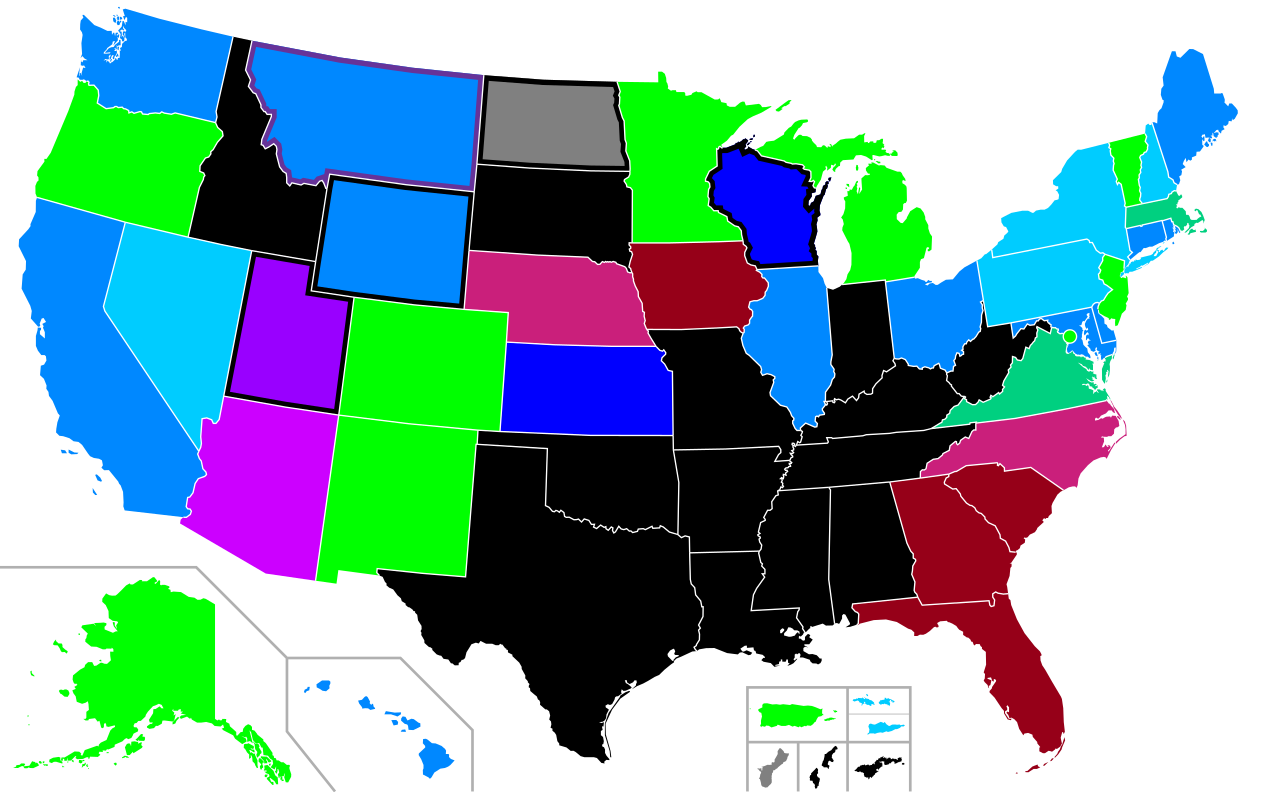
In the United States, abortion is a divisive issue in politics and culture wars. Prior to the mid-19th century, English common law formed the basis of abortion law in the colonies and the early Republic. Connecticut was the first state to regulate abortion in 1821; it outlawed abortion after quickening, the moment in pregnancy when the pregnant woman starts to feel the fetus's movement in the uterus, and forbade the use of poisons to induce one post-quickening. Many states subsequently passed various laws on abortion until the Supreme Court of the United States decisions of Roe v. Wade and Doe v. Bolton decriminalized abortion nationwide in 1973. The Roe decision imposed a federally mandated uniform framework for state legislation on the subject. It also established a minimal period during which abortion is legal, with more or fewer restrictions throughout the pregnancy. That basic framework, modified in Planned Parenthood v. Casey (1992), remained nominally in place, although the effective availability of abortion varied significantly from state to state, as many counties had no abortion providers. Casey held that a law could not place legal restrictions imposing an "undue burden" for "the purpose or effect of placing a substantial obstacle in the path of a woman seeking an abortion of a nonviable fetus." In December 2021, the FDA legalized telemedicine provision of medication abortion pills with delivery by mail, but many states have laws which restrict this option. In 2022, Roe and Casey were overturned in Dobbs v. Jackson Women's Health Organization, ending protection of abortion rights by the United States Constitution and allowing individual states to regulate any aspect of abortion not preempted by federal law. Since 1976, the Republican Party has generally sought to restrict abortion access based on the stage of pregnancy or to criminalize abortion, whereas the Democratic Party has generally defended access to abortion and has made contraception easier to obtain. The abortion-rights movement advocates for patient choice and bodily autonomy, while the anti-abortion movement advocate that the fetus has a right to live. Historically framed as a debate between the pro-choice and pro-life labels, most Americans agree with some positions of each side. Support for abortion gradually increased in the U . beginning in the early 1970s, and stabilized during the 2010s. The abortion rate has continuously declined from a peak in 1980 of 30 per 1,000 women of childbearing age (15–44) to 11 by 2018. In 2018, 78% of abortions were performed at 9 weeks or less gestation, and 92% of abortions were performed at 13 weeks or less gestation. By 2023, medication abortions accounted for 63% of all abortions. Almost 25% of women will have had an abortion by age 45, with 20% of 30 year olds having had one. In 2019, 60% of women who had abortions were already mothers, and 50% already had two or more children. Increased access to birth control has been statistically linked to reductions in the abortion rate. The first state to decriminalize abortion prior to Roe was Hawaii. As of 2025, Alaska, Arizona, California, Colorado, Illinois, Kansas, Maryland, Michigan, Minnesota, Missouri, Montana, New York, Ohio, Vermont, and Wyoming have a right to abortion in their state constitutions, either explicitly or as interpreted by the state supreme court. Other states, such as Massachusetts and Oregon, protect abortion under state law. The state constitutions of Alabama, Arkansas, Louisiana, Tennessee, and West Virginia explicitly contain no right to an abortion, while the state constitution of Nebraska prohibits abortion after the first trimester.

Infobox

Court
Western District of Louisiana
Started
October 3, 2025 (2025-10-03)
Docket nos.
6:25-cv-01491 (W . La.) 26-30203 (5th Cir.) 25A1207 and 25A1208 (Supreme Court)
Appealed to
Fifth Circuit
Subsequent action
5th Circuit order stayed by Supreme Court via shadow docket
Judge sitting
David C. Joseph

Tables

· Legal status › Penalties by state
Abortion providers
Abortion providers
State
Abortion providers
Sentence
Patients getting abortions
Alabama
Alabama
State
Alabama
Sentence
Performing an abortion is a Class A felony punishable by imprisonment for at least 10 years up to 99 years or life. Attempting to perform an abortion is a Class C felony punishable by imprisonment for at least 1 year and 1 day up to 10 years.
Sentence
None authorized by the state's ban on abortion.
Arkansas
Arkansas
State
Arkansas
Sentence
Performing or attempting to perform an abortion is an unclassified felony punishable by imprisonment not to exceed 10 years and/or a maximum fine of $100,000.
Sentence
None authorized by the state's ban on abortion.
Idaho
Idaho
State
Idaho
Sentence
Performing an abortion is a felony punishable by imprisonment for not less than 2 and not more than 5 years and/or a maximum fine of $5,000.
Sentence
Purposely terminating a pregnancy other than by live birth is a felony punishable by imprisonment for not less than 1 and not more than 5 years and/or a maximum fine of $5,000.
Indiana
Indiana
State
Indiana
Sentence
Performing an illegal abortion is a Level 5 felony punishable by imprisonment for 1 to 6 years and/or a fine of up to $10,000.
Sentence
None authorized by the state's ban on abortion.
Kentucky
Kentucky
State
Kentucky
Sentence
Intentional termination of life of an unborn human being is a class D felony punishable by imprisonment for not less than 1 and not more than 5 years.
Sentence
None authorized by the state's ban on abortion.
Louisiana
Louisiana
State
Louisiana
Sentence
Committing an abortion is punishable by imprisonment for not less than one year and not more than ten years and/or a fine of not less than $10,000 or more than $100,000.
Sentence
None authorized by the state's ban on abortion.
Mississippi
Mississippi
State
Mississippi
Sentence
Performing or attempting to perform an abortion is punishable by imprisonment for not less than 1 year and not more than 10 years.
Sentence
None authorized by the state's ban on abortion.
North Dakota
North Dakota
State
North Dakota
Sentence
Performing an abortion is a class C felony punishable by imprisonment for a maximum of five years and/or a fine of $10,000.
Sentence
None authorized by the state's ban on abortion.
Oklahoma
Oklahoma
State
Oklahoma
Sentence
Performing or attempting to perform an abortion is a felony punishable by imprisonment for a term not to exceed ten years and/or a maximum fine of $100,000.
Sentence
None authorized by the state's ban on abortion.
South Dakota
South Dakota
State
South Dakota
Sentence
Procurement of abortion is a class 6 felony punishable by up to two years imprisonment and/or a fine of $4,000.
Tennessee
Tennessee
State
Tennessee
Sentence
Performing or attempting to perform an abortion is a class C felony punishable by imprisonment for not less than 3 years and not more than 15 years.
Sentence
None authorized by the state's ban on abortion.
Texas
Texas
State
Texas
Sentence
Performing or attempting to perform an abortion is a first-degree felony if an unborn child ("an individual living member of the homo sapiens species from fertilization until birth, including the entire embryonic and fetal stages of development") dies as a result of the offense punishable by imprisonment of not less than 5 years and not more than 9
Sentence
None authorized by the state's ban on abortion.
Utah
Utah
State
Utah
Sentence
Killing an unborn child (not defined in the statute) is a second-degree felony punishable by imprisonment for not less than 1 and not more than 15 years.
West Virginia
West Virginia
State
West Virginia
Sentence
Performing an illegal abortion is a felony punishable by imprisonment for a minimum of 3 years and a maximum of 10 years.
Sentence
None authorized by the state's ban on abortion.
State
Sentence
Abortion providers
Patients getting abortions
Alabama
Performing an abortion is a Class A felony punishable by imprisonment for at least 10 years up to 99 years or life. Attempting to perform an abortion is a Class C felony punishable by imprisonment for at least 1 year and 1 day up to 10 years.
None authorized by the state's ban on abortion.
Arkansas
Performing or attempting to perform an abortion is an unclassified felony punishable by imprisonment not to exceed 10 years and/or a maximum fine of $100,000.
None authorized by the state's ban on abortion.
Idaho
Performing an abortion is a felony punishable by imprisonment for not less than 2 and not more than 5 years and/or a maximum fine of $5,000.
Purposely terminating a pregnancy other than by live birth is a felony punishable by imprisonment for not less than 1 and not more than 5 years and/or a maximum fine of $5,000.
Indiana
Performing an illegal abortion is a Level 5 felony punishable by imprisonment for 1 to 6 years and/or a fine of up to $10,000.
None authorized by the state's ban on abortion.
Kentucky
Intentional termination of life of an unborn human being is a class D felony punishable by imprisonment for not less than 1 and not more than 5 years.
None authorized by the state's ban on abortion.
Louisiana
Committing an abortion is punishable by imprisonment for not less than one year and not more than ten years and/or a fine of not less than $10,000 or more than $100,000.
None authorized by the state's ban on abortion.
Mississippi
Performing or attempting to perform an abortion is punishable by imprisonment for not less than 1 year and not more than 10 years.
None authorized by the state's ban on abortion.
North Dakota
Performing an abortion is a class C felony punishable by imprisonment for a maximum of five years and/or a fine of $10,000.
None authorized by the state's ban on abortion.
Oklahoma
Performing or attempting to perform an abortion is a felony punishable by imprisonment for a term not to exceed ten years and/or a maximum fine of $100,000.
None authorized by the state's ban on abortion.
South Dakota
Procurement of abortion is a class 6 felony punishable by up to two years imprisonment and/or a fine of $4,000.
Tennessee
Performing or attempting to perform an abortion is a class C felony punishable by imprisonment for not less than 3 years and not more than 15 years.
None authorized by the state's ban on abortion.
Texas
Performing or attempting to perform an abortion is a first-degree felony if an unborn child ("an individual living member of the homo sapiens species from fertilization until birth, including the entire embryonic and fetal stages of development") dies as a result of the offense punishable by imprisonment of not less than 5 years and not more than 9
None authorized by the state's ban on abortion.
Utah
Killing an unborn child (not defined in the statute) is a second-degree felony punishable by imprisonment for not less than 1 and not more than 15 years.
West Virginia
Performing an illegal abortion is a felony punishable by imprisonment for a minimum of 3 years and a maximum of 10 years.
None authorized by the state's ban on abortion.
Abortion rate per 1,000 women, 2021 · Statistics › Abortion and ethnicity
African American women
Ethnicity
African American women
Abortion rate
28
Hispanic women
Hispanic women
Ethnicity
Hispanic women
Abortion rate
12
Other women
Other women
Ethnicity
Other women
Abortion rate
9
White women
White women
Ethnicity
White women
Abortion rate
6
Ethnicity
Abortion rate
African American women
28
Hispanic women
12
Other women
9
White women
6
· Statistics › Reasons for abortions
25 %
25 %
Percentage of women
25 %
Primary reason for choosing an abortion
Want to postpone childbearing
21 %
21 %
Percentage of women
21 %
Primary reason for choosing an abortion
Cannot afford a baby
14 %
14 %
Percentage of women
14 %
Primary reason for choosing an abortion
Has relationship problem or partner does not want pregnancy
12 %
12 %
Percentage of women
12 %
Primary reason for choosing an abortion
Too young; parent(s) or other(s) object to pregnancy
10 %
10 %
Percentage of women
10 %
Primary reason for choosing an abortion
Having a child will disrupt education or employment
7 %
7 %
Percentage of women
7 %
Primary reason for choosing an abortion
Want no (more) children
3 %
3 %
Percentage of women
3 %
Primary reason for choosing an abortion
Risk to fetal health
2 %
2 %
Percentage of women
2 %
Primary reason for choosing an abortion
Risk to maternal health
2 %
2 %
Percentage of women
2 %
Primary reason for choosing an abortion
Other
Percentage of women
Primary reason for choosing an abortion
25 %
Want to postpone childbearing
21 %
Cannot afford a baby
14 %
Has relationship problem or partner does not want pregnancy
12 %
Too young; parent(s) or other(s) object to pregnancy
10 %
Having a child will disrupt education or employment
7 %
Want no (more) children
3 %
Risk to fetal health
2 %
Risk to maternal health
2 %
Other
· Statistics › Reasons for abortions
71%
71%
Percentage of women
71%
Reasons contributing to a late abortion
Woman did not recognize she was pregnant or misjudged gestation
48%
48%
Percentage of women
48%
Reasons contributing to a late abortion
Woman had found it hard to make arrangements for an earlier abortion
33%
33%
Percentage of women
33%
Reasons contributing to a late abortion
Woman was afraid to tell her partner or parents
24%
24%
Percentage of women
24%
Reasons contributing to a late abortion
Woman took time to decide to have an abortion
8%
8%
Percentage of women
8%
Reasons contributing to a late abortion
Woman waited for her relationship to change
8%
8%
Percentage of women
8%
Reasons contributing to a late abortion
Someone had earlier pressured woman not to have abortion
6%
6%
Percentage of women
6%
Reasons contributing to a late abortion
Something changed some time after woman became pregnant
6%
6%
Percentage of women
6%
Reasons contributing to a late abortion
Woman did not know timing is important
5%
5%
Percentage of women
5%
Reasons contributing to a late abortion
Woman did not know she could get an abortion
2%
2%
Percentage of women
2%
Reasons contributing to a late abortion
A fetal problem was diagnosed late in pregnancy
11%
11%
Percentage of women
11%
Reasons contributing to a late abortion
Other
Percentage of women
Reasons contributing to a late abortion
71%
Woman did not recognize she was pregnant or misjudged gestation
48%
Woman had found it hard to make arrangements for an earlier abortion
33%
Woman was afraid to tell her partner or parents
24%
Woman took time to decide to have an abortion
8%
Woman waited for her relationship to change
8%
Someone had earlier pressured woman not to have abortion
6%
Something changed some time after woman became pregnant
6%
Woman did not know timing is important
5%
Woman did not know she could get an abortion
2%
A fetal problem was diagnosed late in pregnancy
11%
Other
· Statistics › Reasons for abortions
74%
74%
Percentage of women
74%
Reason for choosing to have an abortion
Having a baby would dramatically change my life
73%
73%
Percentage of women
73%
Reason for choosing to have an abortion
Cannot afford a baby now
48%
48%
Percentage of women
48%
Reason for choosing to have an abortion
Do not want to be a single mother or having relationship problems
38%
38%
Percentage of women
38%
Reason for choosing to have an abortion
Have completed my childbearing
32%
32%
Percentage of women
32%
Reason for choosing to have an abortion
Not ready for another child
25%
25%
Percentage of women
25%
Reason for choosing to have an abortion
Do not want people to know I had sex or got pregnant
22%
22%
Percentage of women
22%
Reason for choosing to have an abortion
Do not feel mature enough to raise a(nother) child
14%
14%
Percentage of women
14%
Reason for choosing to have an abortion
Husband or partner wants me to have an abortion
13%
13%
Percentage of women
13%
Reason for choosing to have an abortion
Possible problems affecting the health of the fetus
12%
12%
Percentage of women
12%
Reason for choosing to have an abortion
Concerns about my health
6%
6%
Percentage of women
6%
Reason for choosing to have an abortion
Parents want me to have an abortion
1%
1%
Percentage of women
1%
Reason for choosing to have an abortion
Was a victim of rape
less than %
less than %
Percentage of women
less than %
Reason for choosing to have an abortion
Became pregnant as a result of incest
Percentage of women
Reason for choosing to have an abortion
74%
Having a baby would dramatically change my life
73%
Cannot afford a baby now
48%
Do not want to be a single mother or having relationship problems
38%
Have completed my childbearing
32%
Not ready for another child
25%
Do not want people to know I had sex or got pregnant
22%
Do not feel mature enough to raise a(nother) child
14%
Husband or partner wants me to have an abortion
13%
Possible problems affecting the health of the fetus
12%
Concerns about my health
6%
Parents want me to have an abortion
1%
Was a victim of rape
less than %
Became pregnant as a result of incest

References

  1. All states and territories, apart from the Northern Mariana Islands, allow abortion to prevent the woman's imminent deat
  2. Cardiac-cell activity is generally detectable in the 6th week LMP. Allowance beyond this limit is made, at minimum, for
  3. Typically, fetal viability begins in the 23rd or 24th week LMP.
  4. The second trimester is variously defined as through 27th or 28th week LMP. In Massachusetts, the law allows elective ab
  5. Arizona, California, Colorado, Maryland, Michigan, Missouri, Montana, New York, Ohio, and Vermont contain explicit abort
  6. According to the Supreme Court's decision in Roe v. Wade (1973): (a) For the stage prior to approximately the end of the
  7. Opposition and Intimidation: The Abortion Wars and Strategies of Political Harassment
  8. Casey, 505 U . at 877.
  9. CNBC
    https://www.cnbc.com/2022/06/24/roe-v-wade-overturned-by-supreme-court-ending-federal-abortion-rights.html
  10. Publius: The Journal of Federalism
    https://doi.org/10.1093%2Fpublius%2Fpjaa015
  11. "Plenty of Common Ground Found in Abortion Debate"
    http://www.gallup.com/poll/148880/Plenty-Common-Ground-Found-Abortion-Debate.aspx
  12. Political Psychology
    https://onlinelibrary.wiley.com/doi/10.1111/pops.12803
  13. "The New Normal on Abortion: Americans More "Pro-Life""
    http://www.gallup.com/poll/128036/New-Normal-Abortion-Americans-Pro-Life.aspx
  14. "U . Abortion Attitudes Remain Closely Divided"
    https://news.gallup.com/poll/235445/abortion-attitudes-remain-closely-divided.aspx?g_source=link_NEWSV9&g_medium=TOPIC&g_campaign=item_&g_content=U.S.%2520Abortion%2520Attitudes%2520Remain%2520Closely%2520Divided
  15. Morbidity and Mortality Weekly Report
    https://www.ncbi.nlm.nih.gov/pmc/articles/PMC7713711
  16. Guttmacher Institute
    https://www.guttmacher.org/2024/03/medication-abortion-accounted-63-all-us-abortions-2023-increase-53-2020
  17. Guttmacher Institute
    https://www.guttmacher.org/news-release/2017/abortion-common-experience-us-women-despite-dramatic-declines-rates
  18. The New York Times
    https://www.nytimes.com/interactive/2021/12/14/upshot/who-gets-abortions-in-america.html
  19. Parenting
    https://www.parents.com/parenting/i-m-a-mom-and-i-had-an-abortion/
  20. Obstetrics & Gynecology
    https://www.ncbi.nlm.nih.gov/pmc/articles/PMC4000282
Image
Source:
Tip: Wheel or +/− to zoom, drag to pan, Esc to close.