
Topzle Topzle

1989 Tiananmen Square protests and massacre

Updated: Wikipedia source
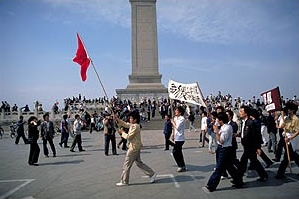
1989 Tiananmen Square protests and massacre

Protests led by students and workers, known in China as the June Fourth Incident, were held in Tiananmen Square in Beijing, China, from 15 April to 4 June 1989. After weeks of unsuccessful attempts between the demonstrators and the Chinese government to find a peaceful resolution, the Chinese government initiated martial law in late May and deployed troops to occupy the square on the night of 3 June in what is referred to as the Tiananmen Square massacre. The events are sometimes called the '89 Democracy Movement, the Tiananmen Square Incident, or the Tiananmen uprising. The Chinese government terms the events as the political turmoil between the spring and summer of 1989. The protests were initiated by the death of former pro-reform Chinese Communist Party (CCP) general secretary Hu Yaobang in April 1989, amid the backdrop of rapid economic development and social change in post-Mao China. The movement's goals reflected anxieties among the people and political elite about the nation's future. Common grievances at the time included inflation, corruption, limited preparedness of graduates for the new economy, and restrictions on political participation. Although the protests were highly disorganised with varying goals, student protestors called for reforms including the rollback of the removal of iron rice bowl jobs, greater political accountability, constitutional due process, democracy, freedom of the press, and freedom of speech. Workers' protests were generally focused on economic issues, specifically inflation and the erosion of welfare. These groups united around anti-corruption demands, adjusting economic policies, and protecting social security. At the height of the protests on May 17, about one million people were assembled in the square. As the protests developed, Chinese authorities responded with both conciliatory and hardline tactics, exposing deep divisions within the party leadership. By May, a student-led hunger strike galvanised support around the country for the demonstrators, and the protests spread to some 400 cities. On 20 May, the State Council declared martial law, and as many as 300,000 troops were mobilized to Beijing, but were halted by mass nonviolent resistance from the protestors and Beijing's civilian population. After several weeks of standoffs and confrontations between the army and demonstrators, a 1 June meeting among the CCP's leadership decided to clear the square. Chinese troops advanced into central parts of Beijing through the city's major highways in the early morning hours of 4 June, and engaged in bloody clashes with demonstrators attempting to block them, in which many people – demonstrators, bystanders, and soldiers – were killed or injured. The vast majority of killings were clustered in Beijing's western suburbs along the Chang'an Avenue. Estimates of the death toll vary from several hundreds to the low thousands, with thousands more wounded. The event had both short and long term consequences. Western countries imposed arm embargoes on China and various Western media outlets labeled the crackdown a massacre. In the aftermath of the protests, the Chinese government suppressed other protests around China, carried out mass arrests of protesters which catalysed Operation Yellowbird, strictly controlled coverage of the events in the domestic and foreign affiliated press, and demoted or purged officials it deemed sympathetic to the protests. The government also invested heavily into creating more effective police riot control units. More broadly, the suppression ended the political reforms which began in 1986 as well as the New Enlightenment movement, and halted the policies of liberalisation of the 1980s, which were only partly resumed after Deng Xiaoping's southern tour in 1992. Considered a watershed event, reactions to the protests set limits on political expression in China that have lasted up to the present day. The events remain one of the most sensitive and most widely censored topics in China.

Infobox

Date
Initial protests: 15 April – 4 June 1989 (1 month, 2 weeks and 6 days) Massacre: 3–4 June 1989 (1 day); 36 years ago
Location
Tiananmen Square, Beijing, China and 400 cities nationwide 39°54′12″N 116°23′30″E / 39 °N 116 °E / 39 ; 116
Caused by
Death of Hu Yaobang Reform and opening up Inflation Political corruption Nepotism in the Communist Party Third wave of democracy
Goals
Ending corruption in the Communist Party, democratic reforms, freedom of the press, freedom of speech, freedom of association, social equality, economic reforms, preservation of welfare
Methods
Hunger strike, sit-in, civil disobedience, protest marches, occupation, rioting
Resulted in
Government crackdown Martial law implemented on May 20 Protests suppressed by force between June 3 and June 4 Heavy casualties from urban clashes between rioters and Chinese soldiers in Beijing, especially in the Muxidi suburbs Protest leaders and pro-democracy activists exiled or imprisoned Rioters charged with violent crimes executed in the following months Zhao Ziyang removed as General Secretary and from the Politburo Jiang Zemin promoted to paramount leader by Deng Xiaoping Imposition of Western sanctions and arms embargoes Initiation of Operation Yellowbird
Deaths
Official CCP Tally: 241 dead Independent Estimates: 300 to 2,700 dead Modern Scholarship: 700 to 2,600 dead

Tables

Student leaders · Beginning of the 1989 protests › Death of Hu Yaobang
Chai Ling
Chai Ling
Name
Chai Ling
Origin and affiliation
Shandong; Beijing Normal University
Wu'erkaixi (Örkesh)
Wu'erkaixi (Örkesh)
Name
Wu'erkaixi (Örkesh)
Origin and affiliation
Xinjiang; Beijing Normal University
Wang Dan
Wang Dan
Name
Wang Dan
Origin and affiliation
Beijing; Peking University
Feng Congde
Feng Congde
Name
Feng Congde
Origin and affiliation
Sichuan; Peking University
Shen Tong
Shen Tong
Name
Shen Tong
Origin and affiliation
Beijing; Peking University
Wang Youcai
Wang Youcai
Name
Wang Youcai
Origin and affiliation
Zhejiang; Peking University
Li Lu
Li Lu
Name
Li Lu
Origin and affiliation
Hebei; Nanjing University
Zhou Yongjun
Zhou Yongjun
Name
Zhou Yongjun
Origin and affiliation
China University of Political Science and Law
Name
Origin and affiliation
Chai Ling
Shandong; Beijing Normal University
Wu'erkaixi (Örkesh)
Xinjiang; Beijing Normal University
Wang Dan
Beijing; Peking University
Feng Congde
Sichuan; Peking University
Shen Tong
Beijing; Peking University
Wang Youcai
Zhejiang; Peking University
Li Lu
Hebei; Nanjing University
Zhou Yongjun
China University of Political Science and Law

References

  1. including 23 soldiers and policemen
  2. excluding some 20 soldiers and policemen
  3. Chinese: 六四事件; pinyin: liùsì shìjiàn
  4. Chinese: 八九民运; pinyin: Bājiǔ mínyùn
  5. Chinese: 天安门事件; pinyin: Tiān'ānmén shìjiàn
  6. Chinese: 1989年春夏之交的政治风波; pinyin: 1989 Nián Chūnxià Zhījiāo de Zhèngzhì Fēngbō
  7. Analyst Richard Baum described their actions as ".. mock-ceremonial remonstrance... presenting their scrolled-up demands
  8. Zou Bing (邹冰; victim No. 51), a 19-year-old student at the Beijing Broadcasting Institute, hanged herself in September 1
  9. Jay Mathews, former Beijing bureau chief for The Washington Post said that "as far as can be determined from the availab
  10. Richard Roth reported that he was held captive by troops in the Great Hall of the People on the west side of the square
  11. Quartz
    https://qz.com/698990/261-ways-to-refer-to-the-tiananmen-square-massacre-in-china/
  12. Los Angeles Times
    https://www.latimes.com/world-nation/story/2021-06-24/china-world-history-erasure-youth-censorship
  13. Los Angeles Times
    https://www.latimes.com/world/asia/la-fg-china-tiananmen-looking-back-20190530-story.html
  14. "As China Cracks Down on Dissent, New York City Gives Refuge to Exhibit Remembering Tiananmen Square"
    https://www.usnews.com/news/best-states/new-york/articles/2023-06-01/as-china-cracks-down-on-dissent-new-york-city-gives-refuge-to-exhibit-remembering-tiananmen-square
  15. Brook 1998, p. 216.
  16. Lim 2014a, pp. 34–35.
  17. Nathan 2001.
  18. The Transformation of Chinese Socialism
    https://doi.org/10.2307%2Fj.ctv113199n
  19. D. Zhao 2001, p. 171.
  20. Saich 1990, p. 172.
Image
Source:
Tip: Wheel or +/− to zoom, drag to pan, Esc to close.